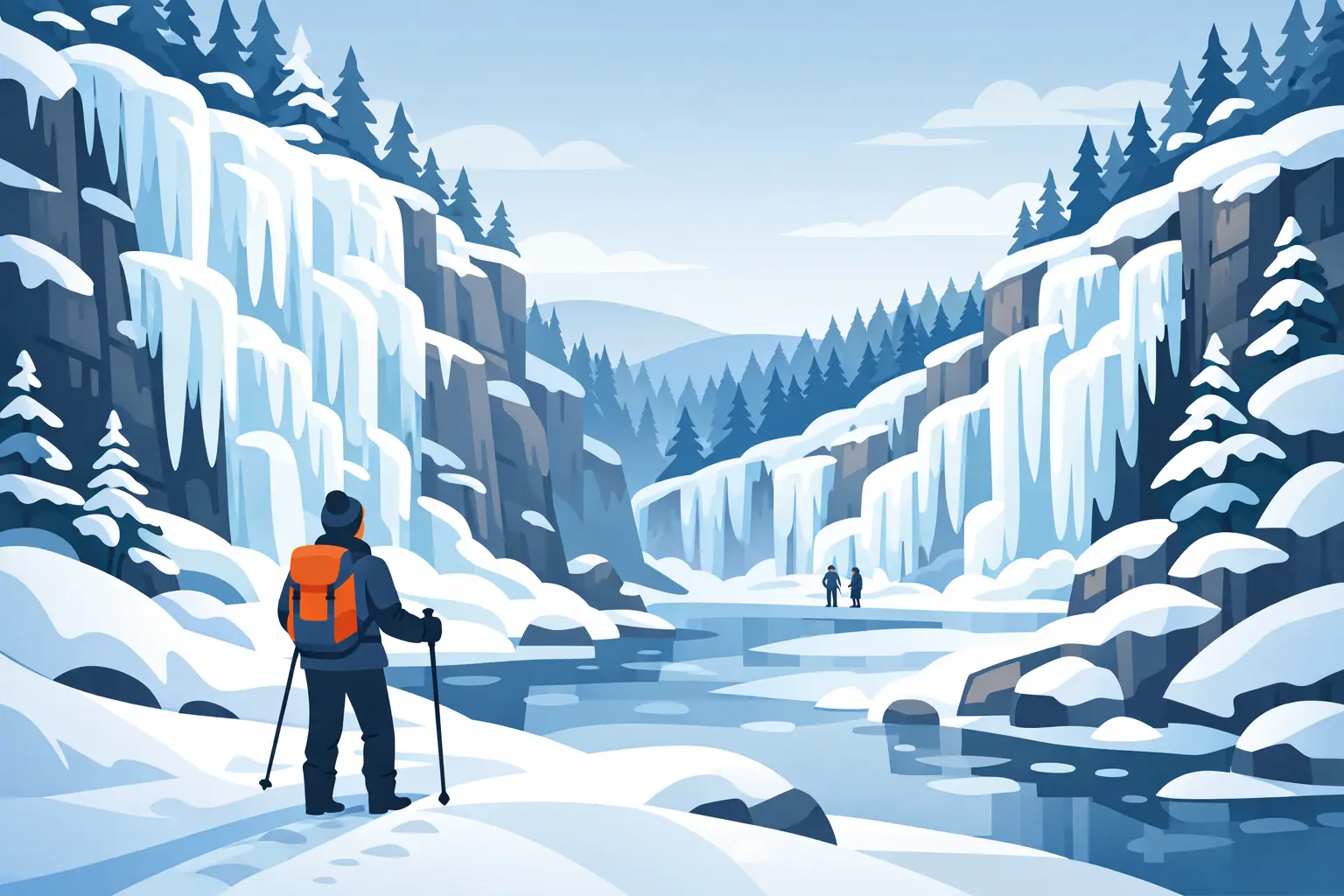
Some winter places feel staged for photographs. Korouoma does not. The best Korouoma frozen waterfalls hike gives you something better – a real day out in Lapland, where the forest stays quiet, the canyon walls rise around you, and huge blue-white icefalls appear between the trees like they were never meant to be ordinary.
For many travellers based in Rovaniemi, this is one of the most memorable winter walks you can do in a day. It has the fairy-tale factor people hope for when they book Lapland, but it also asks for a bit of respect. Snow underfoot, cold air in the canyon, and a route that feels manageable for some and surprisingly tiring for others – this is not a theme-park stroll. That is exactly why it stays special.
Why the best Korouoma frozen waterfalls hike stands out
Korouoma Nature Reserve is famous for its frozen waterfalls, but what makes the experience so strong is the setting around them. You are not just walking to one viewpoint, taking a quick picture, and heading back to the car. You move through a proper Arctic landscape – deep forest, ravine edges, river sections, wooden bridges, and multiple ice formations that change character depending on temperature and snowfall.
That variety matters. Some winter attractions in Lapland are brilliant but very curated. Korouoma feels wilder. You still get an accessible day trip from Rovaniemi, but once you are on the trail, the atmosphere shifts. It is quieter, more elemental, and more rewarding if you enjoy being in nature rather than simply ticking off a landmark.
It is also one of those rare hikes that works for different kinds of travellers. Couples love it for the drama and scenery. Families with older children often find it adventurous without being extreme. Small groups of friends get a proper winter outing instead of just a short activity slot. The trade-off is that fitness, footwear, and weather make a real difference to how much you enjoy it.
What the route is actually like
The route most visitors mean when they talk about the best Korouoma frozen waterfalls hike is the circular trail that takes you down into the canyon and past the main frozen waterfalls. Distances can vary a little depending on conditions and the exact start point used, but you should expect roughly 5 kilometres in practice for the classic loop, with uneven snowy ground and some ascents and descents that feel more demanding in winter than the number suggests.
That is the first thing many visitors underestimate. Five kilometres in packed snow is not the same as five kilometres on a dry pavement back home. Add layers, boots, slippery patches and sub-zero temperatures, and even a moderate route can feel like a proper workout.
The trail usually begins in forest before dropping towards the canyon. From there, the path opens into the reserve’s most striking sections, where frozen waterfalls cling to rock faces in towering columns and curtains of ice. Some are broad and sculptural, others look almost delicate until you stand beside them and realise their scale. If you are lucky with light, the ice takes on soft blue tones that look almost unreal.
The loop format helps. You keep moving through changing scenery, which makes the day feel like a journey rather than an out-and-back trudge. There are sections where you will want to stop often, especially if you enjoy photography, but there are also stretches where your focus turns practical – watching your footing, managing body temperature, and keeping a steady pace.
Is it difficult?
In good winter conditions, most reasonably active adults will find the Korouoma hike achievable. That said, achievable and easy are not the same thing. If you rarely walk, struggle with balance, or are travelling with very young children, it may feel tougher than expected.
The route can involve slippery ground, compact snow, short steeper sections, and cold that bites harder when you stop. For experienced hikers, this is unlikely to feel technical. For casual holidaymakers, it is more accurate to think of it as a moderate winter walk with adventurous flavour.
This is where guided travel makes a difference. A good guide does more than lead the way. They pace the group, help with footing, read the conditions, and make the day feel relaxed instead of uncertain. If you are visiting Lapland for a short break and want the magic without the stress of self-navigation, that support is worth a lot.
When to go for the best experience
The best Korouoma frozen waterfalls hike is usually at its most iconic in the heart of winter, when the waterfalls are fully formed and the canyon feels properly Arctic. The exact timing changes year to year, but the main season generally sits between December and March.
If your dream is a deep-snow, frozen-fantasy landscape, January and February often deliver the strongest winter atmosphere. Trees are heavily coated, temperatures stay low, and the waterfalls are solid and dramatic. The downside is obvious – it can be very cold, and daylight is limited.
March brings a different kind of beauty. There is often more light, which helps for photos and makes the day feel longer and more open. Conditions can still be excellent, but the mood shifts slightly from midwinter mystery to brighter, sunnier adventure. Neither is better for everyone. It depends whether you want the full frozen fairytale or a more comfortable hiking day with clearer visibility.
What to wear and bring
Your day at Korouoma will be shaped by what is on your feet more than by what is in your camera bag. Warm, insulated winter boots with proper grip are essential. Trainers are not enough, and fashionable city boots often disappoint once the trail gets packed or icy.
Layering is the other big one. Start with a moisture-wicking base layer, add insulation such as fleece or wool, and finish with a windproof winter jacket. Trousers need to handle snow and cold, ideally with some weather protection. Gloves, a hat, and a neck warmer are standard, not optional.
If you tend to feel the cold, bring hand warmers and an extra layer for stops. Hikers often cool down fast when they pause near the waterfalls to take photos. A small backpack with water and snacks helps, because winter walking burns more energy than many expect. If conditions are icy, traction aids can be useful, though what you need depends on the day and whether your guide or operator provides advice in advance.
Is it suitable for families?
Yes, often – but not automatically. Families with older children who enjoy walking and can manage cold conditions usually get a lot out of this hike. The setting feels adventurous, the waterfalls are genuinely exciting to see, and the day has that sense of earning the view rather than just arriving by coach.
For very young children, the answer is more mixed. The route length may sound modest, but winter terrain changes everything. Tired legs, cold fingers, and repeated stops can turn a magical day into a long one. If your family enjoys active days outdoors, it can be brilliant. If your ideal winter excursion is low effort and highly sheltered, another Lapland activity may suit you better.
Why many visitors choose a guided hike
Korouoma is one of those destinations that looks straightforward online and feels more complex in real life. Road conditions, parking, trail choice, weather shifts, and winter kit all add friction. When you only have a few days in Lapland, spending half of one figuring out logistics is not always the best use of your holiday.
A guided tour keeps the experience focused on what you came for – the landscape, the frozen waterfalls, and the feeling of being out in the Arctic with people who know it well. Small groups are especially valuable here. They move more smoothly, create less waiting on narrow sections, and keep the atmosphere personal rather than rushed. That is very much the kind of real, nature-first experience we believe in at ArKtictopia.
There is also a safety advantage that should not be overlooked. Winter hiking is not dangerous by default, but it is less forgiving of poor preparation. A guide can adjust the pace, spot issues early, and keep the day enjoyable for mixed-ability travellers.
Tips for getting the most from the hike
Start with realistic expectations. You do not need to be a mountaineer, but you do need to be ready for a proper winter walk. If you treat it like a serious outdoor activity rather than a casual wander, you are more likely to love it.
Give yourself time at the waterfalls instead of racing around the loop. Korouoma is best when you pause, listen to the stillness, and take in the shapes and colours of the ice. It is one of those places where the atmosphere matters as much as the headline sight.
And if you are building a Lapland itinerary, place this hike wisely. It pairs well with more relaxed experiences such as a sauna evening, a gentle wildlife visit, or an easier activity the following day. Stack too many physically demanding winter tours back to back and even magical places can start to feel like hard work.
Korouoma earns its reputation because it still feels wild, even when it is popular. Go prepared, go with enough time, and let the day unfold properly. That is usually how the best memories in Lapland happen.