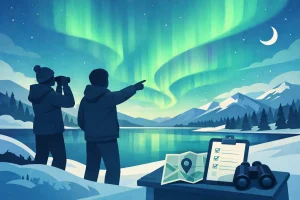
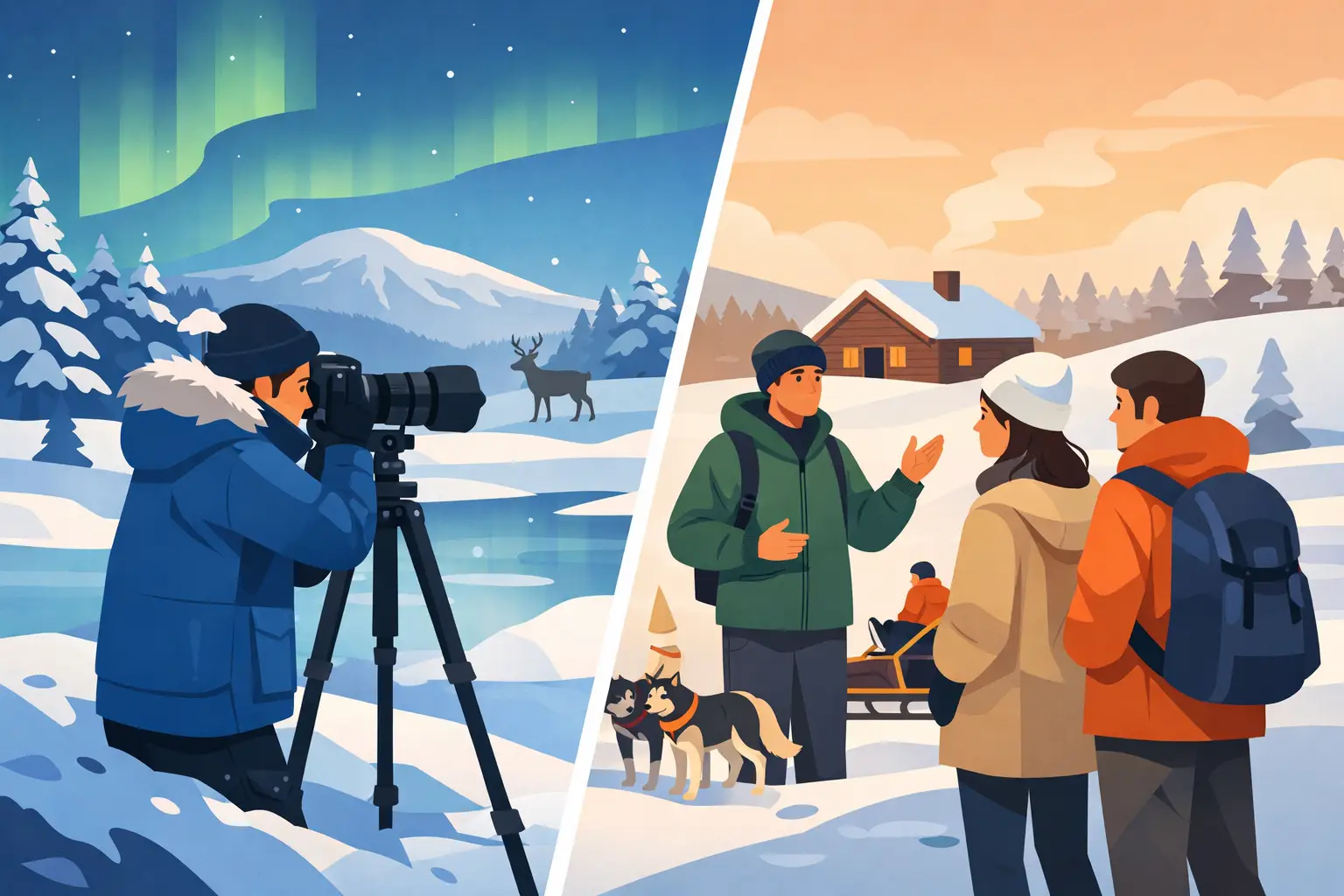
The Northern Lights appear, pale at first, then suddenly alive above a frozen lake. In that moment, choosing a Lapland photography tour or standard tour changes more than the pictures you take. It changes where you stand, how long you stay, how your guide responds to the sky, and whether you are focused on your camera settings or simply looking up in wonder.
Both tour styles can lead to an unforgettable Arctic night. The right choice depends on what you want to bring home: a powerful memory, a portfolio-worthy image, or a little of both.
Lapland photography tour or standard tour: the real difference
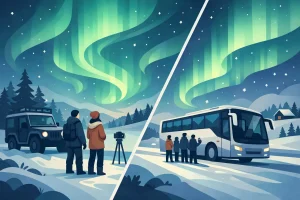
A standard Northern Lights hunt is built around the experience of finding the aurora. You travel with a guide away from city glow, follow the best forecast and cloud conditions available, and wait in carefully chosen wilderness locations. There is time for photographs, warm drinks and stories, but the night is designed for everyone – couples with one mobile phone between them, families, first-time aurora hunters and travellers who want to feel the magic without thinking about shutter speed.
A photography tour is more focused. Your guide chooses locations not only for clearer skies, but for foregrounds, compositions and light conditions that can make an image feel truly Arctic. Think snow-covered pines, a dark lake edge, an open fell or a traditional wilderness shelter glowing against the blue hour. The pace is usually more patient, with practical help to set up your camera and time to return to the same scene when the aurora strengthens.
Neither is automatically better. A standard hunt is often the best choice if this is your first evening beneath Arctic skies and you want to be present for every second. A photography-focused experience is the stronger fit if creating high-quality images is part of the reason you came to Lapland.
Choose a standard tour if the experience comes first
The aurora does not run to a timetable. It may arrive early, build slowly after midnight, or appear in a brief gap between clouds. On a standard tour, your guide handles the demanding parts: route planning, weather checks, safe transport, warm stops and the search for darkness. You can put your energy into enjoying the journey.
This format works especially well for couples and small groups with different confidence levels. One person can take photos while another leaves their gloves on, watches the sky and enjoys the fire. If you are travelling with children, simplicity matters even more. Long exposure settings and tripod adjustments are not much fun for a cold child who would rather hear the snow crunch under their boots.
Standard tours are also ideal for mobile phone photographers. Modern mobile phones can capture a surprising amount in low light, particularly when the aurora is strong. Your guide can help you find the best position, reduce stray light and take a keepsake photo of you under the sky where possible. You may not return with a print-ready nightscape, but you can still take home images that bring the moment rushing back.
A standard experience is not a lesser version of an aurora hunt. The priority is simply different: less technical pressure, more freedom to absorb the fairy-tale atmosphere of the Arctic night.
Choose a Lapland photography tour for more than a snapshot
A photography tour suits travellers who already own a camera with manual settings, or who are keen to learn how to use one in real conditions. Northern Lights photography is not just about pointing a camera upwards. You need a stable tripod, a wide lens that performs well in low light, enough battery power and the confidence to adjust settings quickly when the sky changes.
Your guide can make that learning curve far less intimidating. They can help you balance shutter speed, aperture and ISO, focus accurately in darkness, frame the scene and avoid common mistakes such as leaving image stabilisation on while the camera is mounted on a tripod. These details matter. A beautifully active aurora can still become a soft green blur if your settings are wrong.
Photography tours also give more attention to the landscape. The goal is not only proof that the Northern Lights appeared. It is to create an image with a sense of place: Arctic forest, untouched snow, reflections, stars or the human scale of a traveller beneath the sky. That usually means more deliberate stops and occasional periods of quiet while everyone works on a composition.
Be realistic about the conditions, though. A photography tour cannot promise a perfect image any more than any aurora hunt can promise clear skies. Cloud cover, solar activity, wind, moonlight and your own camera all play a role. What a specialist tour gives you is stronger preparation, more suitable locations and expert guidance when opportunity arrives.
What camera kit should you bring?
A DSLR or mirrorless camera with manual controls is the most flexible option. Bring a fast wide-angle lens if you have one, a sturdy tripod, a spare battery kept warm in an inside pocket and plenty of memory card space. Cold temperatures drain batteries quickly, so do not leave your only charged battery inside the camera all evening.
A remote shutter release can help, but it is not essential if your camera has a self-timer. Keep your equipment simple enough to use with warm gloves nearby. This is Lapland, not a studio. You may be setting up on snow in the dark while the lights begin to move.
If you only have a mobile phone, do not rule yourself out. Ask whether the tour welcomes mobile photography and bring a small tripod if possible. Just set your expectations around the tool you have. A mobile phone is brilliant for sharing the memory; a dedicated camera gives you more room to create something considered.
Think about your group, not just your camera
The best tour must suit the people travelling with you. If everyone is an enthusiastic photographer, a dedicated photo hunt lets the whole group enjoy the same slower, more purposeful rhythm. Nobody feels rushed while changing lenses, and nobody is left wondering why the group has stopped again.
If one person loves photography and the others do not, a standard small-group hunt may be the happier compromise. The photographer can still shoot, while everyone else enjoys the warmth, wilderness and aurora without a technical agenda. Alternatively, a private hunt can give your group more freedom to set the pace around your own priorities.
Small groups make a difference in both formats. They mean more personal help, less waiting around at stops and a guide who can respond to the people in front of them. At ArKtictopia, that personal attention is part of The Real experience: an Arctic adventure shaped by the night, not a rigid coach timetable.
Aurora success is about conditions and commitment
Be cautious of anyone who suggests that a photography tour has better Northern Lights simply because it is labelled for photographers. The aurora is a natural phenomenon. A skilled guide can chase clearer skies, read local weather patterns and keep moving when conditions demand it, but no operator controls the solar wind.
What can improve your odds is choosing a tour designed to maximise time in the right conditions. A mobile hunt that is willing to travel beyond Rovaniemi when the forecast calls for it can be more valuable than a short, fixed-location outing. Longer hunts may also give the sky more time to change. The trade-off is a later night and potentially more time on the road.
For photography, darkness matters too. A bright moon can make the landscape beautifully visible, yet it can reduce contrast in a faint aurora. Fresh snow, meanwhile, can reflect enough light to create a magical foreground. There is no single perfect forecast. A good guide understands how to work with the night you are given.
Before you book, ask yourself one honest question
Would you be disappointed if you spent half the evening adjusting camera settings and missed part of the show with your own eyes? If the answer is yes, choose a standard tour and take a few simple photographs when the moment feels right. The memory will not be weaker because you were looking at the sky instead of the screen.
If you would be equally disappointed to see the aurora and come home without giving your photography a proper chance, book the photography option. Pack for the cold, practise your camera controls before departure and arrive ready to be patient.
The Arctic rewards both approaches. Stand still when the sky begins to dance, listen to your guide, and let the night be bigger than the image you hoped to make.