A cheap bus ticket can look tempting when you are watching your Lapland budget. But the Rovaniemi aurora tour vs bus choice is not really about transport. It is about what happens after darkness falls, clouds move in, and the green lights appear somewhere far beyond the city glow.
Rovaniemi is a brilliant base for an Arctic holiday, yet the Northern Lights do not perform on a timetable. You may need to change direction, drive further than expected, wait for a gap in the cloud, or simply stay outside long enough for a faint arc to become a magical display. That is where a proper aurora hunt and a standard bus journey become very different experiences.
Rovaniemi aurora tour vs bus: the real difference
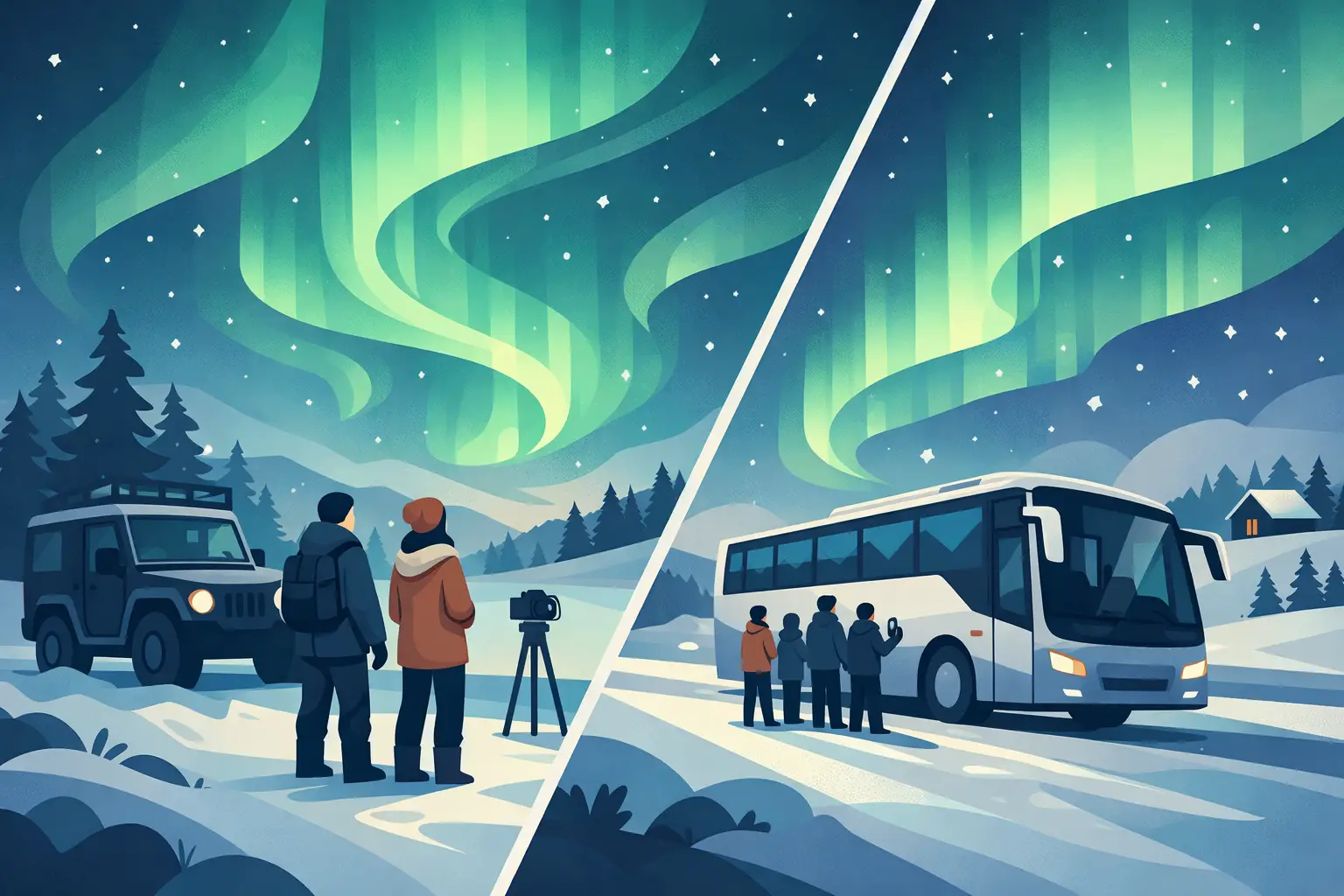
An aurora tour is built around one goal: giving you the best realistic chance of seeing the Northern Lights. A guide monitors the weather, reads the changing conditions, chooses a viewing area and handles the Arctic practicalities so you can focus on the sky. Depending on the tour, the group may travel to several locations, cross into clearer weather systems, warm up around a fire, and receive help with camera settings.
A bus, by contrast, gets you from one fixed point to another. This could mean a local public bus to a village outside Rovaniemi, or a large coach excursion that advertises Northern Lights viewing. Neither option is automatically bad. The key question is whether it has the freedom, local knowledge and time to react when the conditions change.
That distinction matters because a clear sky is usually more valuable than a high aurora forecast. If cloud covers Rovaniemi but the horizon looks promising 80 kilometres away, a fixed bus stop cannot chase it. A dedicated hunt can.
What you get with an aurora hunting tour
A good small-group aurora tour begins before you step into the vehicle. Guides check cloud maps, wind patterns, road conditions and aurora activity, then make a routing decision based on the best information available that evening. It is not guesswork, and it is not a promise that nature will obey. It is a focused effort to put you in the right place at the right time.
On the road, flexibility is the advantage. Your guide may head west, east or north of Rovaniemi, avoiding streetlights and searching for open skies. If a location is too cloudy, the group can move on. If the aurora strengthens, you can stay. That responsive approach is especially valuable during short winter breaks, when every night in Lapland feels precious.
There is also the human side. Arctic darkness can be exhilarating, but it can feel intimidating if you have never stood on a frozen lakeshore at minus 20 degrees. A guide knows where it is safe to walk, how to keep the group comfortable and when to return to warmth. They can explain what you are seeing, from a soft grey-green band to the sudden, unforgettable dance of colour overhead.
For photographers, guidance can make a huge difference. Northern Lights images often need manual settings, a stable surface and patience. A photography-focused hunt gives you time and help rather than leaving you to wrestle with your camera in the cold. Mobile phone photos can work too, particularly with newer models, but expectations should stay realistic: the camera may reveal more colour than your eyes see at first.
When a bus can be the sensible option
A bus makes sense if your aim is simply to leave the brightest parts of Rovaniemi independently. For example, you might use public transport to reach a nearby area, stay overnight outside the city, and watch the sky from your accommodation. This can be a relaxed choice for confident travellers who are comfortable planning around timetables, walking in snow and accepting that they may not find the best conditions.
Large coach trips can also suit travellers who want the lowest-cost organised option and are happy with a straightforward evening outing. You will usually have transport, a designated viewing location and a guide or host. For families with very young children, a fixed, shorter programme can sometimes feel easier than a longer chase.
The trade-off is simple: a bus is generally less flexible. It may follow the same route every night, stop at one location, operate with a larger group and return at a set time even if the sky is improving. It is an excursion to an aurora spot, not always an active hunt for clear skies.
The question to ask before booking
Do not choose only by price or by the word “aurora” in the product name. Ask how the experience works on a cloudy night.
Will the vehicle move to another location if conditions are poor? How far can the group travel from Rovaniemi? Is the tour limited to one camp or viewing site? How many guests share the experience? Is there time to wait for activity, and does the operator provide warm clothing or refreshments?
These details tell you whether you are booking transport to a scenic place or a genuine effort to find the lights. Neither is inherently wrong, but they are worth different amounts of your holiday time and money.
Be equally cautious of absolute promises. No operator can control cloud cover or solar activity. A responsible aurora company talks about maximising your chances, not manufacturing the Northern Lights. Some products may offer a second attempt or a particular policy if no aurora is seen, but read the terms carefully. A “guarantee” can mean different things, from a return trip to a defined service promise.
Cost versus value on a Lapland holiday
Public transport is the cheapest route, followed by big bus excursions, while small-group and private hunts typically cost more. But value is not just the ticket price. Consider the cost of losing one of only three available nights to a cloudy, fixed-location trip.
A small-group hunt often includes the things that make the night feel special rather than logistical: hotel pick-up, warm guidance, a route chosen for the conditions, stories around the fire and personal support when the lights appear. You are paying for decision-making, not just a seat.
Private tours sit at the other end of the scale. They are ideal for couples planning a proposal, photographers wanting more control, families who prefer their own pace, or friends who want a completely personal Arctic night. Your guide can tailor stops, timings and practical support to your group. If seeing the lights is the centrepiece of your trip, that freedom can be worth it.
ArKtictopia’s small-group hunts are designed for travellers who want that real, nature-first experience: fewer people, personal attention and the flexibility to go where the sky is better. It is the difference between joining a queue at a viewpoint and feeling that the wilderness has opened just for your group.
Choose by your travel style, not just your budget
Choose a bus if you are travelling independently, want a low-cost outing and are comfortable taking a chance on a single area. It can be a perfectly enjoyable way to spend an evening outside Rovaniemi, especially if the forecast is clear and you have several nights available.
Choose an aurora tour if this is a once-in-a-lifetime goal, you only have limited evenings in Lapland, or you want local expertise without the stress of winter driving and weather apps. A hunt is particularly worthwhile when forecasts are mixed, because those are the nights when route decisions matter most.
Choose a private or photography tour when the experience needs to fit around your own people, pace or creative plans. You will not make the aurora appear, but you can give yourselves more comfort, more time and more control over the night.
Give yourself more than one chance
Whatever you book, plan at least two or three aurora nights if your itinerary allows. The Northern Lights are a natural phenomenon, not a theatre show, and even the best guide cannot remove every variable. The strongest strategy is to stay flexible: book an active hunt early in your trip, keep later evenings free where possible, and treat any extra sighting as a bonus.
Dress for standing still rather than walking. Thermal layers, warm socks, insulated boots, mittens and a hat make waiting under the stars far more enjoyable. Bring a power bank, as batteries drain quickly in the cold, and leave a little room for wonder. The first glow may be quiet. Stay patient. In Lapland, the sky often saves its best moment for those willing to wait.