You can spend an hour refreshing an aurora app in your hotel room, see a promising number, step outside, and still find nothing but cloud. That is exactly why the question of aurora hunt or forecast watching matters so much in Lapland. If your winter holiday is short, your timing matters, and the difference between a magical night and a missed chance often comes down to knowing what the forecast can do – and what it simply cannot.
Aurora hunt or forecast watching: what is the real difference?
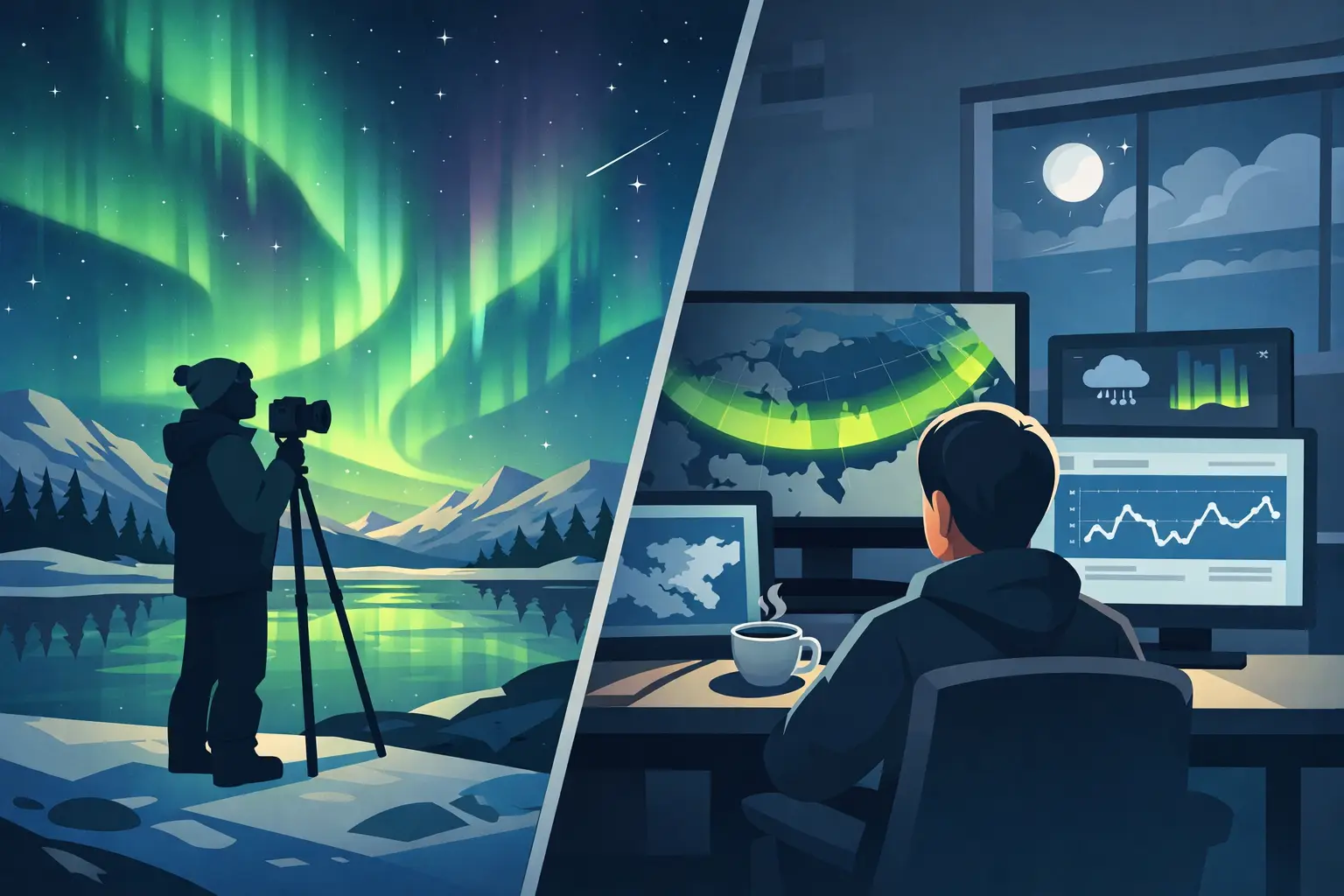
Forecast watching is passive. You check KP values, cloud maps, solar wind data and local weather, then decide whether to head out. Aurora hunting is active. You build the evening around movement, local knowledge, flexible routing and real-time decisions to maximise your chances of seeing the lights.
That difference sounds simple, but it changes everything. A forecast can tell you if there is potential. It cannot clear a patch of cloud above your exact location, predict the perfect gap at the perfect time, or tell you which back road, frozen lakeside or forest clearing has the darkest sky tonight. A proper hunt can.
In Finnish Lapland, especially around Rovaniemi, conditions shift fast. One area can sit under thick cloud while another, an hour away, opens into a clear sky. A static plan works only when the weather behaves. The Arctic does not always feel like being cooperative.
What forecast watching gets right
Forecasts are useful. Very useful, in fact. Anyone claiming otherwise is overselling the drama.
If you are planning your evening, an aurora forecast gives context. A stronger geomagnetic forecast can suggest a better chance of activity. Cloud cover maps help you avoid obvious disappointment. Local temperature, moonlight and the time of night all matter too. If the sky is fully overcast across a huge region and activity is weak, no amount of optimism will turn that into a great viewing night.
Forecast watching is also handy for travellers who are staying several nights and have total flexibility. If you have a car, know the roads, understand winter driving, and do not mind waiting for the right window, checking conditions can help you choose the strongest night to go out.
But this is where many visitors get caught out. They treat a forecast as a promise. It is not. KP is not a booking confirmation from the sky. Even on a modest forecast, the aurora can still appear beautifully if the skies are clear and you are in the right place. On a strong forecast, clouds can ruin everything.
Why aurora hunting usually beats staying put
An aurora hunt is built for uncertainty, and that is the whole point.
When you join a guided hunt, you are not just paying for transport. You are paying for decisions made in real time by people who know the terrain, the weather patterns and the practical limits of the night. That means knowing when to leave early, when to wait, when to drive south instead of north, and when a less obvious viewing spot is worth the detour.
That local decision-making matters most on borderline nights. If cloud is broken rather than solid, a hunt can chase the gaps. If the aurora is active but low on the horizon, a guide can take you somewhere with a cleaner view and less light pollution. If one stop fails, the evening does not end there.
For most visitors, especially couples, families and small groups on a short Lapland holiday, this active approach gives you a far better use of time. Instead of second-guessing apps and staring at maps you do not fully trust, you can actually be out in the landscape, with a proper plan and someone adapting it as conditions change.
The truth about aurora forecasts in Lapland
The best way to use a forecast is as one tool, not the entire strategy.
A forecast is strongest when it helps shape expectations. It tells you whether tonight looks quiet, promising or wildly unpredictable. It helps operators organise routes and departure decisions. It can even influence which type of experience suits you best – a shorter local trip, a longer hunt, or a private outing with maximum flexibility.
Where it falls short is precision. Auroras are tied to space weather, but your night on the ground depends just as much on local cloud, darkness, terrain and timing. That is why experienced guides often care less about one dramatic number on an app and more about how all the conditions line up together.
This is also why travellers sometimes have their best aurora night when the forecast looked only average. Clear skies and patient positioning often beat big hype and bad weather.
When forecast watching is enough
There are moments when forecast watching makes perfect sense.
If you are already deep in the countryside, far from city lights, with open views and several nights ahead, staying flexible on your own can work well. The same is true if you are an experienced winter traveller who is comfortable reading local weather patterns and driving in proper Arctic conditions after dark.
It can also be enough if your expectations are relaxed. Some travellers are happy to step outside their cabin a few times, enjoy the silence, and treat the aurora as a bonus. That is a lovely way to experience Lapland if seeing the lights is not the main event.
But many visitors do not come that far north for a casual maybe. They want the real chance, not just the romantic idea of one.
When an aurora hunt makes more sense
If you are in Lapland for only a few nights, an aurora hunt is usually the smarter choice. That is especially true if one of the main reasons for your trip is seeing the Northern Lights.
It also makes sense if you are travelling with children, if you do not want the stress of driving on icy roads, or if you simply want the evening handled properly from start to finish. Pick-up, route planning, warm stops, timing and safety all become part of the experience rather than separate problems to solve.
There is also the emotional side of it. A great hunt does not feel like sitting around waiting for a notification. It feels like an adventure. You head into dark forests, frozen landscapes and quiet roads with purpose. Even before the first green ribbon appears, the night already has momentum.
That matters more than people expect. The best Arctic experiences are not only about the outcome. They are about how the evening feels while you are chasing it.
The trade-off: freedom versus expertise
So, aurora hunt or forecast watching? The honest answer is that it depends on how much is riding on the night.
Forecast watching gives you independence. It can save money, keep things spontaneous and work well if you have time to spare. But it asks more of you – confidence, patience, mobility, and a willingness to get it wrong.
Aurora hunting gives you expertise and adaptability. It is the stronger option when your holiday is short, your expectations are high, or you want a more personal and outcome-focused experience. The trade-off is simple: you are investing in better odds, not buying certainty.
No trustworthy operator should promise the sky on command. Nature does not work that way. What a good hunt can promise is that the night will be organised around maximising your chances in a way forecast watching alone cannot match.
The smartest approach is both
The strongest strategy is not choosing one and ignoring the other. It is using forecasts as the starting point, then hunting actively when the conditions deserve it.
That is how experienced guides work. They watch the data, read the sky, track the cloud, and then go. The forecast informs the plan. The hunt delivers the flexibility. Put those together, and you move from hopeful guessing to a much sharper approach.
For travellers coming to Rovaniemi and wider Lapland, that balance is often where the magic happens. Not in obsessing over every app refresh, and not in blindly driving into the dark, but in combining smart planning with real Arctic know-how. That is the spirit behind the best Northern Lights experiences, and it is why companies such as ArKtictopia build evenings around chasing the right conditions rather than waiting passively for luck.
If the aurora is high on your wish list, do not leave the whole night to a number on a screen. Watch the forecast, yes – then give yourself a real chance to meet the sky properly.