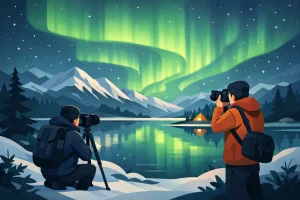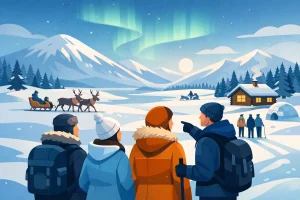
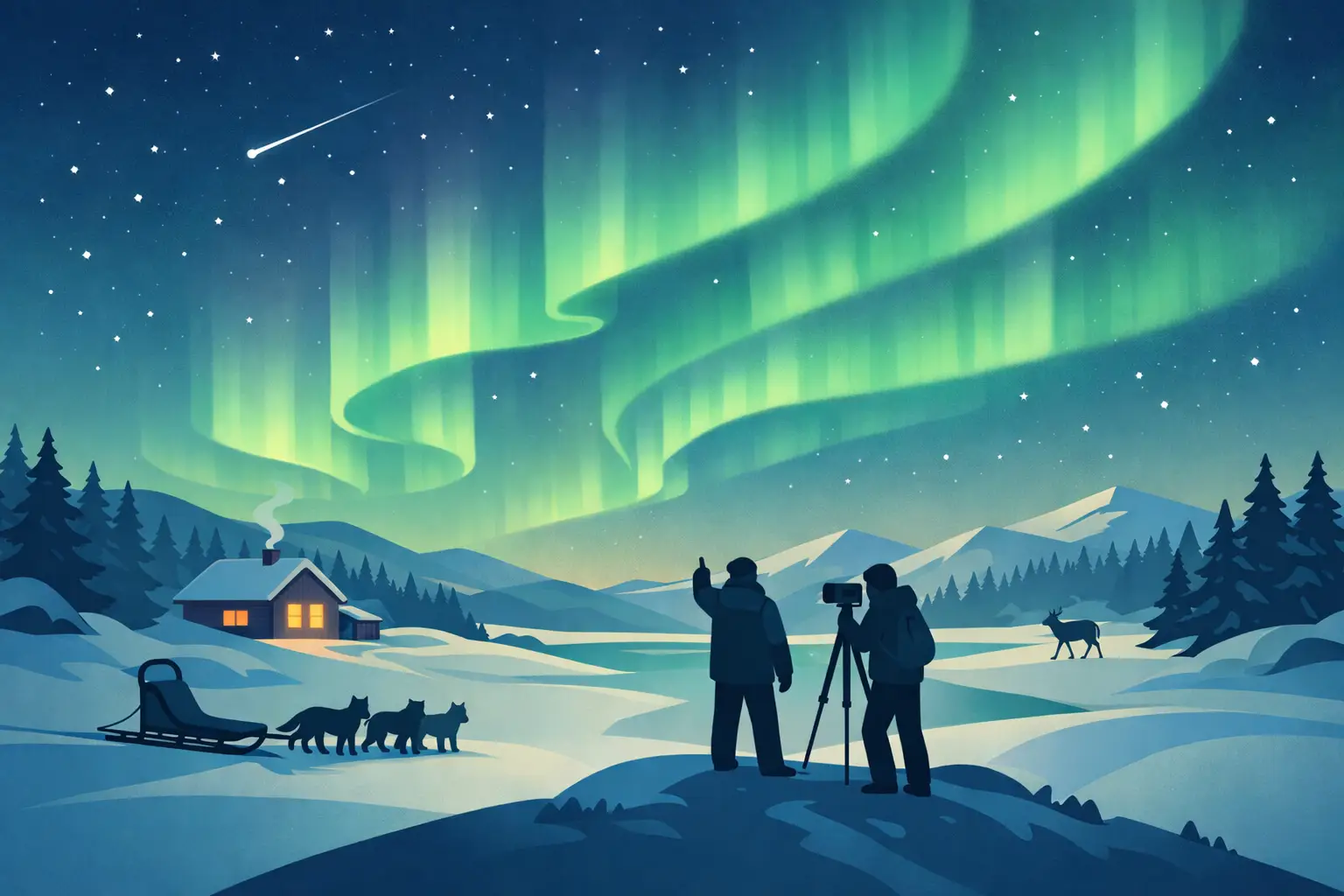
A bright green ribbon appears above a frozen lake, shifts shape for a few minutes, then disappears behind cloud. That is the magic and the frustration of the Arctic sky. So, is an aurora tour worth it in Lapland? For most first-time visitors, yes – provided you book it for the right reason: not a promise of lights, but the strongest possible chance to meet them in the wild.
A Northern Lights tour is not simply transport into the dark. A good hunt combines weather knowledge, local routes, safe driving, warm breaks and the confidence to leave the lights of Rovaniemi behind when the forecast says the sky is clearer elsewhere. It turns an uncertain night into a proper Arctic adventure.
Is an aurora tour worth it in Lapland for your trip?
It depends on how much your holiday time matters. If you have only two or three nights in Finnish Lapland, spending one of them trying to decode cloud maps, hiring a car, finding a legal place to park and wondering whether that faint streak is a cloud or an aurora can feel like a gamble. A guided tour removes the awkward logistics and lets you focus on the sky.
The real value is in mobility. Rovaniemi is an excellent winter base, but the Northern Lights do not perform on demand above one fixed location. Cloud cover can be thick in town while a clearer patch waits an hour or two away. An experienced guide watches conditions, reads the forecast and is ready to change direction. Sometimes the best viewing point is a snowy forest track. Sometimes it is a wide-open lakeside where the horizon feels endless.
That flexibility matters more than dramatic promises. Nobody can control solar activity or move a blanket of cloud with positive thinking. What a dedicated aurora hunt can do is give you more opportunities, better locations and someone beside you who knows when patience is worthwhile and when it is time to move.
What you are really paying for
A cheap coach trip that stops at a crowded viewpoint is very different from a small-group Northern Lights hunt. Price alone does not tell the whole story, but it should prompt useful questions: how far can the tour travel, how large is the group, how long is spent outside, and what happens if clouds roll in?
On a well-run tour, you are paying for the work that happens before the first pick-up. Guides check forecasts from several sources, assess road conditions and plan possible routes. During the hunt, they make decisions in real time. That might mean travelling farther north, waiting for a break in the clouds, or choosing a sheltered stop where you can warm up beside a fire while keeping an eye on the sky.
Small groups make the night feel more personal, too. You can ask questions, get help adjusting your camera and enjoy the silence without being surrounded by dozens of people holding phones overhead. At ArKtictopia, that personal attention is part of The Real experience: fewer distractions, more wilderness and guides who want the night to feel unforgettable whether the sky delivers a full display or a quiet shimmer.
When a guided hunt is absolutely worth it
An aurora tour is particularly worthwhile if you are travelling without a car, visiting Lapland for the first time, or feel uneasy about winter driving. Arctic roads are well maintained, but darkness, snow, ice and unfamiliar routes deserve respect. Letting a professional handle the driving means you can sit back, stay warm and watch for the first signs of green.
It is also a smart choice for couples and families who want the experience to feel special rather than stressful. You do not need specialist outdoor skills to stand under the Northern Lights, but you do need the right clothing, a safe place to stop and enough warmth to stay outside when the temperature drops well below freezing. Guides help with all of that, while bringing the local stories that turn a dark landscape into something alive.
Photography is another reason to join a tour. The aurora often looks more vivid in a camera image than to the naked eye, especially during a gentle display. A guide can help you use night mode on your phone or set a longer exposure on a camera. More importantly, they can place you somewhere with a foreground worth photographing: frosted pines, a snowy trail, a lake or a traditional campfire scene.
When you might not need one
If you are staying for a week or longer, have a hire car, are comfortable driving on winter roads and genuinely enjoy tracking weather, self-hunting can be rewarding. You may prefer the freedom to stay at one quiet spot for hours, return to a favourite lake or head out whenever solar activity rises.
Even then, one guided night can be a wise start. You learn how guides read the conditions, discover places you would not find alone and get a better sense of what the aurora actually looks like. It is also worth remembering that a self-drive hunt has its own costs: vehicle hire, fuel, winter gear, parking uncertainty and the risk of spending a precious night in the wrong place.
A tour may be less suitable if your only goal is a guaranteed photograph for social media. The Northern Lights are a natural phenomenon, not a stage show. Choose a tour because you want the whole experience – the cold air, the star-filled darkness, the crackle of a fire and the thrill of watching the sky change.
How to choose the right Lapland aurora tour
Look beyond phrases such as ‘Northern Lights tour’ and check how the night is designed. A fixed-location camp can be cosy and family-friendly, but it may not be the strongest option when clouds are moving through. A mobile hunt is built around chasing clearer skies, while a private hunt gives your group maximum flexibility and a photography-focused tour allows more time for camera support.
Ask about group size and duration. Aurora visibility can improve late in the evening, so a rushed trip with only a short stop may not suit travellers who want a proper hunt. Find out whether warm drinks, winter overalls or snacks are included, and whether pick-up is available from your accommodation. Clear communication is a good sign that the operator takes the full experience seriously.
Do not be drawn in by a guarantee unless you understand what it means. A ‘guaranteed’ hunt may refer to a second attempt, an extended search or a particular service policy. It cannot mean guaranteed Northern Lights in the sky. Honest operators say this plainly while still working hard to maximise every possible opportunity.
Give yourself more than one chance
The best aurora strategy is not to place all your hopes on one evening. Book your hunt early in your Lapland stay if you can. If the clouds win on night one, you still have time to try again independently or arrange another tour. Avoid filling every evening with fixed activities, especially during a short winter break.
Check the forecast, but do not obsess over aurora apps. They are useful indicators, not verdicts. A moderate aurora beneath clear skies can be far more memorable than high activity hidden by thick cloud. Guides look at the complete picture: cloud layers, wind direction, road access, moonlight and the changing window of darkness.
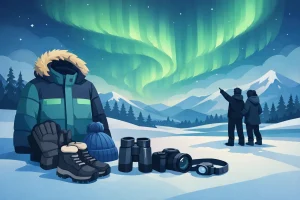
Dress as if you will be standing still, because you probably will be. Thermal base layers, warm socks, insulated boots, mittens, a hat and a proper outer layer make a huge difference. When your feet are warm and your hands are free to hold a camera or cup of berry juice, waiting becomes part of the pleasure.
The night is still an adventure
The Northern Lights may be the headline, but the feeling of an aurora hunt starts long before the first colour appears. It is the moment town lights fade behind you. It is stepping into snow that squeaks beneath your boots. It is looking up and realising how many stars a truly dark sky can hold.
That is why a good tour is worth it even on a quieter night. You are not buying a coloured sky. You are giving yourself access to Lapland at its most raw, peaceful and magical – with a guide who knows where to go when the Arctic decides to show its hand.
Give the sky more than one night, choose a hunt that can move with the weather, and let the rest of the experience matter too. If green light begins to dance above the trees, you will be exactly where you need to be.