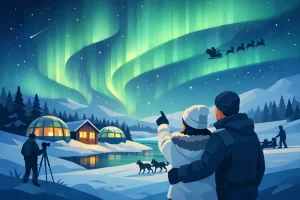
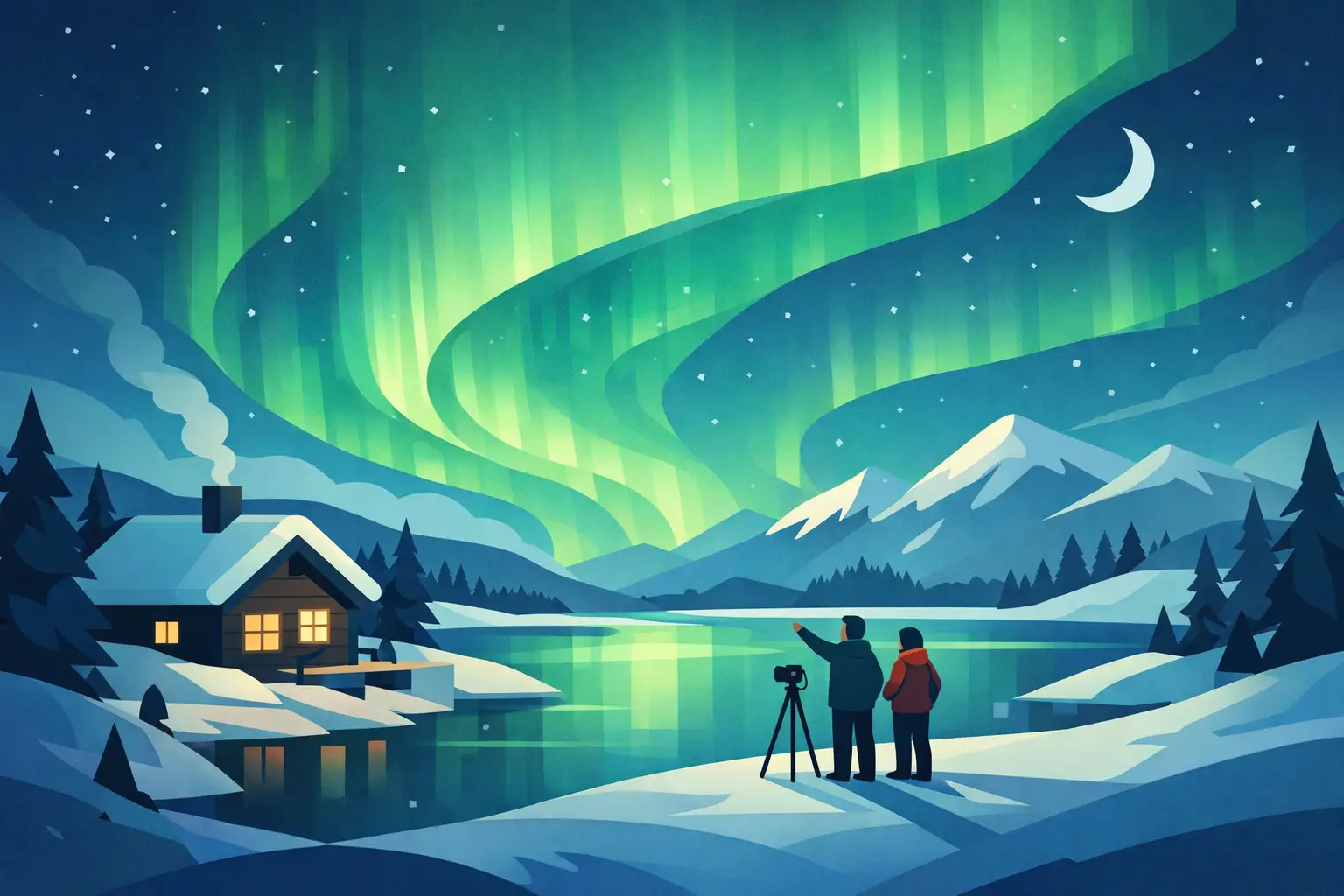
If you are trying to pin down what month best for aurora Lapland, here is the honest answer first: there is no single perfect month for everyone. There is, however, a best month for your kind of trip.
That matters more than people expect. Some travellers want the highest chance of seeing the Northern Lights. Others want deep snow, husky rides, frozen forests and that full fairy-tale Lapland feeling. Some are coming over Christmas and are happy to trade a bit of aurora probability for atmosphere. Others would gladly skip Santa crowds for longer nights and quieter roads. Lapland gives you all of it, just not always at the same moment.
For most travellers, February and March are the sweet spot. If you want one month to circle on the calendar, March is often the strongest all-round pick. But that does not mean September, October, November, December or January are wrong. It means they each bring a different version of the Arctic.
What month is best for aurora in Lapland?
If the question is purely what month is best for aurora in Lapland, many local guides would point you towards March. By then, you still have long dark hours, winter is fully established, snow cover is usually excellent, and road conditions for getting out into the wilderness are often more reliable than in the shoulder weeks. In many years, the weather can also feel a little more stable than early winter.
That said, aurora sightings are never about one month alone. You need three things to line up: solar activity, dark enough skies, and breaks in the cloud. Solar activity cannot be booked like a table for dinner. The two factors you can influence are timing and where you hunt. That is why guided trips matter so much in Lapland. A proper aurora hunt is not just standing outside your cabin for ten minutes and hoping for green. It is reading the forecast, watching cloud movement, driving to the right microclimate, and being ready to move again if the sky closes.
Why March is often the best all-round choice
March has a lot going for it. The days are getting brighter, which makes the whole trip feel more energetic, but nights are still dark enough for proper aurora hunting. Snow conditions are usually superb. Lakes are frozen, forests are bright white, and the landscapes around Rovaniemi and beyond look exactly how most people imagine Lapland should look.
For travellers from the UK and wider Europe, this balance is hard to beat. You can spend the day on a husky safari, snowshoe through silent woodland, or head out ice fishing, then still have a strong window for the Northern Lights later on. It is the month that often gives you the fullest version of the winter experience without feeling like you are surviving the Arctic rather than enjoying it.
There is another plus. By March, the low winter sun starts adding beautiful colour to the day. Even when the aurora does not appear, the trip still feels rich. Pale pink horizons, blue twilight on snow, smoke rising from cabins, frozen rivers catching the last light – this is Lapland at its most photogenic.
When each month makes sense
September and October
These are the early aurora season months. Nights return quickly after the summer light, and if the skies are clear, the Northern Lights can already be excellent. The trade-off is simple: you are not guaranteed that classic snowy Lapland look yet, especially early on.
For travellers focused mainly on the aurora itself, autumn can be a brilliant call. Forests can carry rich colour, lakes may still be open, and the air often feels sharp rather than brutally cold. But if your dream includes thick snow, sleigh rides and full winter activities, this may be too early.
November
November is underrated and a bit wild. Darkness increases, which is good for aurora hunting, and winter starts to build. Some years it looks beautifully wintry. Other years it can be transitional, with weather shifting and snow cover still settling.
If you can live with a little unpredictability, November can reward you with a more atmospheric, quieter Lapland. It feels raw, real and very Arctic. If you want certainty on snow-based activities, though, later winter is usually a safer bet.
December
December is magical. There is no other word for it. Christmas lights, heavy snow if conditions line up, and that storybook atmosphere people cross Europe to find. If your trip is about festive Lapland as much as the aurora, December absolutely makes sense.
The trade-off is that this is peak season, especially around Christmas and New Year. Prices are higher, popular experiences book fast, and some visitors arrive with impossible expectations that every night will produce dancing green skies. The Northern Lights do appear in December, but cloud still matters, and the busier holiday period means you want your plans organised well in advance.
January
January is deep winter. The cold can be serious, but so can the beauty. Snow cover is usually strong, nights are long, and the whole landscape feels hushed and pristine. For travellers who want the full frozen north, January delivers.
It can also be one of the most rewarding months for activities. Husky rides, reindeer safaris, snowmobile routes and forest trails all feel properly in season. The challenge is the cold and, for some, the limited daylight. If that does not put you off, January gives you a powerful, unforgettable version of Lapland.
February
February is one of the strongest choices on the board. It keeps the proper winter conditions of January but often feels a touch friendlier in terms of daylight and general trip comfort. The snow is established, activity options are broad, and aurora hunting conditions can be excellent.
For many travellers, February is the month where everything starts to click. You still get that true Arctic feel, but the days begin to open up just enough to make the whole holiday flow beautifully.
March
March is the all-round champion for a lot of people, especially first-time visitors who want both aurora and the classic Lapland experience. It is not automatically the best month for every single aurora sighting, but it is often the best month for the overall trip.
What affects your chances more than the month
The biggest mistake people make is over-focusing on the calendar and underestimating conditions on the ground. Clear skies matter more than minor differences between one winter month and the next. So does mobility.
If you stay in one spot and hope the clouds behave, you are leaving a lot to luck. A guided hunt can change that equation. Experienced guides know when to head away from town lights, which direction to chase a clearing sky, and when patience is worth it. They also know when to say, honestly, that nature is not playing ball tonight.
That honesty is part of the real experience. No one can promise aurora on demand. What a strong operator can do is maximise your chances with route planning, local knowledge and the flexibility to move fast. That is exactly why many travellers base themselves around Rovaniemi and head out with guides who treat aurora hunting as more than a quick transfer to a random parking area.
So when should you book?
If your main goal is the best overall balance, book February or March. If you want one direct answer to what month best for aurora Lapland, go with March.
If you care most about festive atmosphere, choose December. If you want the deepest winter landscapes and do not mind the cold, January is superb. If your focus is more heavily on dark skies and you are less concerned about snow, September and October deserve attention.
The best month also depends on who you are travelling with. Families often love December and February because the broader Lapland experience is so strong. Couples looking for a romantic winter break often do brilliantly in January or March, when the landscapes feel especially cinematic. Solo travellers and photographers may prefer the quieter edges of the season, when they can focus more sharply on conditions and composition.
If you want a trip that feels personal rather than rushed, small-group guiding makes a real difference. That is where brands like ArKtictopia come into their own – not by pretending to control the sky, but by building the right kind of Arctic experience around it.
Lapland is not a place you visit for a perfect guarantee. You go for the stillness, the snow under your boots, the shock of stars over a frozen forest, and the chance that the sky suddenly comes alive. Pick the month that fits the trip you actually want, and the whole experience becomes far more magical.