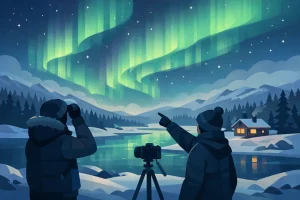
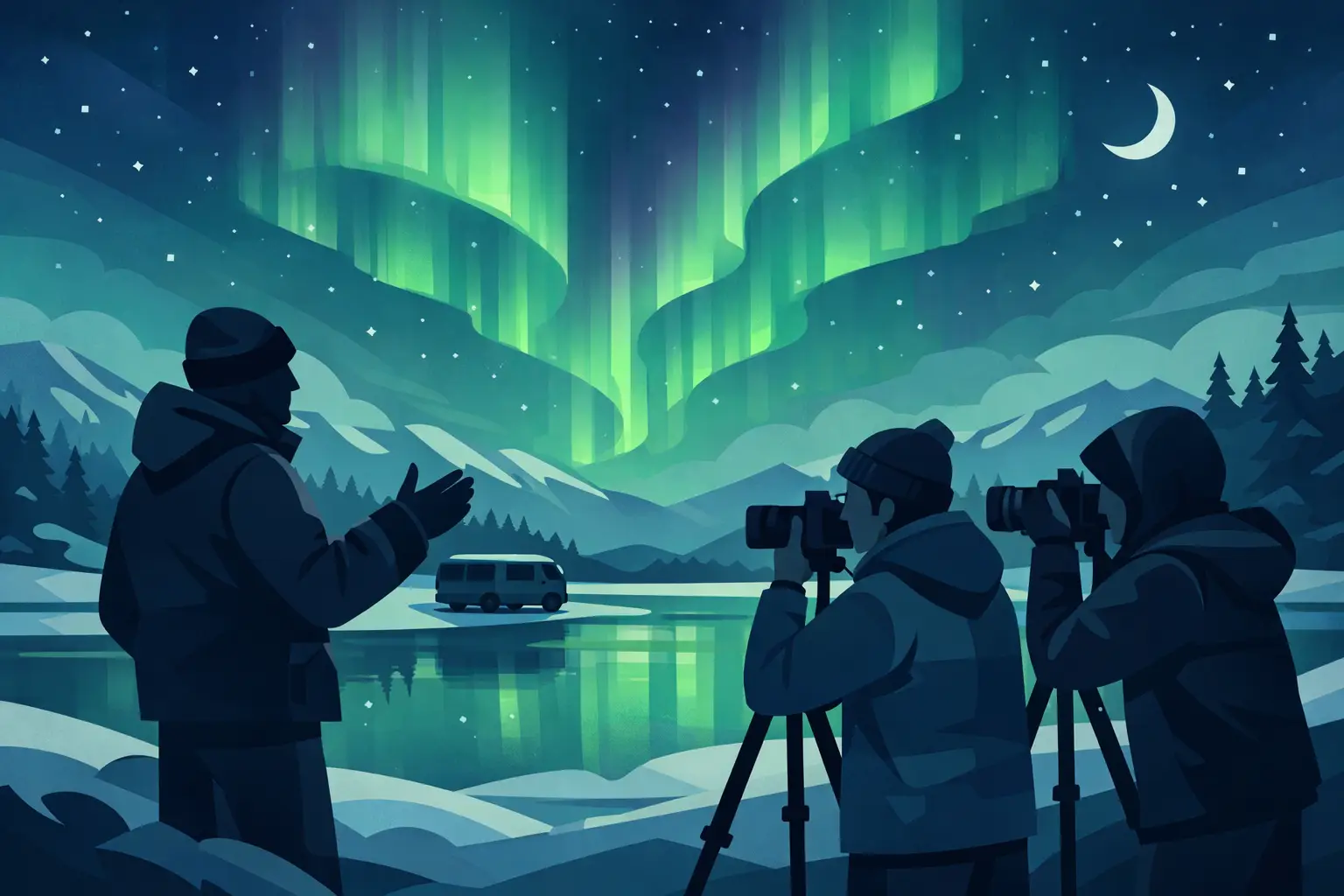
The sky can look completely empty at 8 pm and then, half an hour later, turn into a moving ribbon of green over a frozen lake. That gap between nothing and magic is exactly why travellers ask how guided aurora photography works. It is not just a lift to a dark spot with a camera in your hands. Done properly, it is a mix of forecasting, route planning, weather reading, fieldcraft, patience, technical support, and knowing when to move fast.
For most visitors to Lapland, that matters. You are here for a short winter break, not a season-long photography project. You want the real Arctic night, but you also want structure, warmth, and someone who knows what they are doing when cloud cover shifts, temperatures drop, and your camera settings suddenly make no sense in the dark.
How guided aurora photography works in practice
A guided aurora photography tour starts long before pick-up. The guide is usually checking several factors through the day and again closer to departure – cloud movement, local weather windows, solar activity, moonlight, road conditions, and the likely behaviour of the aurora during the evening. Aurora forecasting is never perfect, and anyone promising certainty is overselling it. What a good guide can do is improve the odds by reading the conditions and building a flexible plan around them.
That is the first big difference between guided aurora photography and simply driving out on your own. The route is not fixed just because it was fixed yesterday. If one area is blocked by cloud and another has a clearer sky inland, the plan changes. If a frozen riverside viewpoint is exposed to wind but a nearby forest opening gives better shelter and a stronger composition, the guide adapts. The work is part science, part local instinct.
Once the tour begins, the evening usually unfolds in stages. There is transport away from light pollution, but the destination is rarely chosen for darkness alone. It also needs enough open sky, safe footing, a good foreground for photographs, and room for people to spread out without trampling through one another’s tripod shots. On small-group tours, that calmer pace makes a real difference. You are not jostling for position or losing time while a large coach group unloads.
Why a guide changes the result
Photographing the Northern Lights looks simple on social media. In reality, it is one of those experiences that becomes much easier when someone experienced is standing beside you. The dark affects everything. Buttons become hard to find, batteries drain faster, autofocus hunts uselessly, and exposure settings that seemed fine indoors fall apart in the field.
A photography guide helps with the details that matter in the moment. That might mean setting a wide aperture, raising ISO to a sensible level, adjusting shutter speed to match the speed of the aurora, or switching to manual focus and checking sharpness on a distant light or star. It can also mean telling you when not to touch anything. The aurora changes quickly, and many people lose their best frames by endlessly fiddling with settings instead of shooting.
There is also the human side. Plenty of guests are excited but nervous, especially if they have never used a tripod properly or only shoot on a phone. A good guide does not turn the night into a lecture. They keep it simple, help you get a result fast, and then build from there if you want to learn more. Some guests want to understand every setting. Others just want one unforgettable portrait under the lights and the reassurance that someone else has thought through the technical bits.
The route, the waiting, and the quick decisions
One reason people underestimate guided aurora photography is that they imagine a straight line from hotel to photo spot to hotel again. Real aurora hunting is rarely that tidy. Sometimes the lights appear early and stay strong. Sometimes you wait for hours under a silent sky and then everything happens in ten minutes. Sometimes the best decision is to leave a perfectly good location because the cloud edge is moving and another site has a better chance.
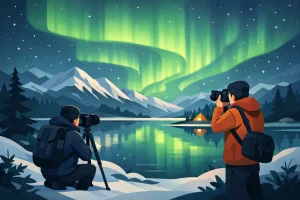
This is where local guiding earns its place. In Finnish Lapland, distance matters, but so does terrain. Open lakes, hilltops, forest clearings, riverbanks, and roadside viewpoints all behave differently under different weather patterns. The ideal place for strong aurora may not be the ideal place for strong photographs. Reflections, snow-covered trees, cabin silhouettes, and clean horizons all affect the final image.
The guide is balancing all of that while also keeping the experience comfortable. That means watching the group, judging how long people can stand still in the cold, planning warm-up moments, and making sure the night stays exciting rather than exhausting. The best tours feel adventurous, not chaotic.
How guided aurora photography works for beginners
If you are not a serious photographer, you are still a good fit for this kind of tour. In fact, many guests book because they have never photographed the Northern Lights before and do not want to waste a rare chance by guessing.
A beginner-friendly guide will usually start with the essentials – how to hold still, how to avoid shaking the camera, where to stand, and what settings to use first. If you are using a DSLR or mirrorless camera, they can help you get off auto mode quickly. If you are using a smartphone, expectations need to be more realistic. Some newer phones can capture the aurora surprisingly well, but results vary hugely depending on the model, the strength of the lights, and whether you can stabilise it properly.
That trade-off matters. A guided photography tour can improve your chances of getting a photo, but it cannot turn every device into a professional camera. Honesty is part of a good experience. The goal is not to pretend all gear performs the same. It is to help you get the best possible result from what you brought.
What happens on a photo-focused tour
On a dedicated photo tour, the pace is usually a little different from a standard aurora hunt. There is often more time spent on composition, portraits, and repeated shooting from the same location if conditions are good. The guide may help set up individual shots, including framed portraits with the aurora behind you, rather than simply pointing everyone at the sky at once.
That can be especially valuable for couples, solo travellers, and small groups who want proof they were really there, not just abstract pictures of green light. A strong aurora photo often needs more than sky. It needs scale, snow, stillness, and a person in the frame to bring the scene to life.
At the same time, photography-focused does not always mean hard-core. Some tours are designed for enthusiasts with interchangeable lenses and spare batteries in every pocket. Others are much more accessible and built around travellers who want guidance, beautiful locations, and a memorable evening without turning it into a technical workshop. It depends on the operator and the tour format.
Small groups make a visible difference
This is one of the least glamorous details, but it affects the night more than most people expect. Small groups are better for guided aurora photography because they are easier to move, easier to brief, and easier to support when the lights suddenly appear.
If the aurora starts dancing overhead, every minute counts. A guide with a smaller group can help multiple guests quickly, spot bad settings before the moment passes, and keep the atmosphere calm. On a larger trip, there is more waiting, more light from screens and torches, and more chance that someone steps straight through your shot.
That is one reason personal attention matters so much on real Arctic experiences. It is not luxury for its own sake. It improves the outcome.
What guided aurora photography does and does not guarantee
The honest answer is simple. A guided tour can never guarantee the Northern Lights themselves. Solar activity, cloud cover, and timing remain outside human control. What it can do is remove a lot of avoidable failure.
It improves your chances of being in the right place at the right time. It gives you access to local knowledge, practical support, safer winter travel, and real-time decision-making. It also means that if the lights do appear, you are much more likely to come home with photographs that actually show what happened.
That is the real value. Not false promises, but better odds, less stress, and a far better experience in the field.
For travellers coming to Lapland for a short, once-in-a-lifetime winter holiday, that support can turn a hopeful outing into one of the most unforgettable nights of the trip. If you want the sky, the silence, the snow, and a photo that brings it all back the moment you look at it, guided aurora photography is not about making the Arctic easier. It is about helping you meet it properly.