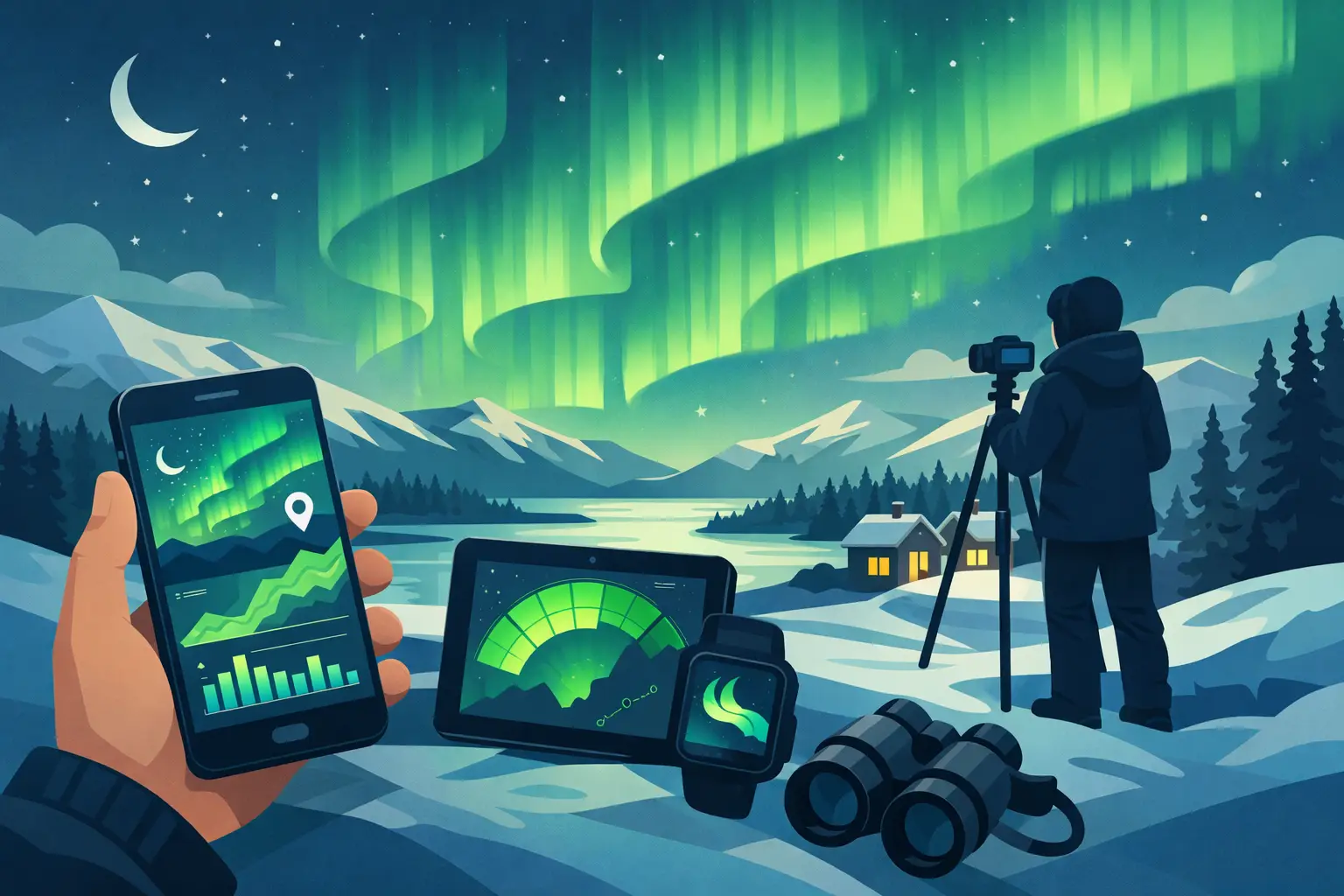
You check the app at 7pm. It says 18 per cent cloud, KP 4, decent chance. By 9pm, the sky over Rovaniemi is sealed shut. Twenty minutes later, just outside the city, the stars crack through and a green arc starts to move. That is Lapland in winter. Beautiful, unpredictable, and far too wild to hand over to a phone screen.
That is why northern lights forecast apps Lapland visitors rely on can be useful, but never the whole story. If you are planning a once-in-a-lifetime winter break, the real skill is knowing what these apps can tell you, what they cannot, and when local judgement matters more than another refresh.
Which northern lights forecast apps Lapland travellers should use
Most aurora apps are trying to answer three separate questions. Is there auroral activity tonight? Will the sky be clear where I am? And if conditions change, where should I go next? No single app nails all three every time, especially in Finnish Lapland where weather shifts fast and local terrain matters.
For most travellers, the strongest approach is to use two or three tools together rather than hunting for one magic app. A dedicated aurora app can give you alerts and activity forecasts. A weather app can help with cloud cover. A map app shows whether your perfect viewing point is actually reachable, dark, and sensible in Arctic conditions.
My Aurora Forecast is popular because it is simple. You get aurora probability, KP index, cloud cover and notifications without needing a degree in space weather. For first-time visitors, that ease matters. The downside is that simple numbers can create false confidence. A high score on the app does not mean the lights will explode over your cabin exactly on cue.
Hello Aurora is more community-driven and often feels a bit more alive because users report sightings in real time. That can be genuinely handy when people nearby are seeing activity. But it also needs a reality check. A report from one location does not mean conditions match yours, and in Lapland, a short drive can take you from heavy cloud into a clear sky or the other way round.
Windy is not built purely for aurora chasing, but it is one of the most useful tools you can have. It gives a far better feel for cloud movement than many aurora-specific apps. If you are staying in Rovaniemi and can travel, this matters. You are often not asking, “Will there be northern lights somewhere above Lapland?” You are asking, “Where is the nearest clear gap in the next two hours?” Windy helps with that question.
YR, the Norwegian weather service app, is another favourite for practical weather reading. It is less flashy than some aurora trackers, but often more grounded where cloud forecasts are concerned. And cloud is frequently the deal-breaker. Strong auroral activity behind a thick blanket of cloud is still a no-show from your point of view.
What the apps get right – and where they mislead
Aurora apps are at their best when they give you a reason to stay alert. They can nudge you outside instead of leaving you in a sauna until midnight. They can show broad trends in solar activity. They can help you compare one evening with the next if your trip lasts several nights.
Where they mislead is in the way many travellers read them. The KP index, for example, gets treated like a promise. In reality, it is only one piece of the puzzle. In Lapland, you can sometimes see impressive aurora on a modest KP night if the sky is dark and clear. You can also have a stronger forecast and see very little because the cloud wins.
Another trap is over-trusting hyper-local precision. Apps often present forecasts as if they are exact to your chosen pin on the map. Out in Arctic conditions, they are not. Snow showers shift, low cloud reforms, and tiny variations in exposure can affect what you actually see. A frozen lake, a forest clearing, or a higher open area may all feel quite different within the same region.
There is also the timing issue. Visitors often check once after dinner and think the night is settled. It rarely works like that. Conditions can improve fast. Some of the most magical sightings happen after a frustrating start, when patience – or a smart move to another location – changes everything.
How to use northern lights forecast apps in Lapland properly
Start with the weather, not the aurora score. If cloud cover looks heavy across your whole area all night, your expectations need adjusting. If there are breaks moving through, that is a much more hopeful sign, even if auroral activity is not looking dramatic.
Next, look at timing. Instead of asking whether tonight is good or bad, ask when the best window might be. Maybe 8pm looks poor but 11pm improves. Maybe the western horizon clears first. That kind of detail helps you plan your evening without burning all your energy too early.
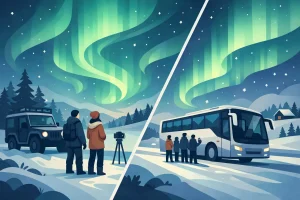
Then think beyond your accommodation. If you are relying on seeing the lights from a hotel courtyard, app data matters less than your surroundings. Street lighting, trees, nearby buildings and local cloud can all work against you. Lapland rewards mobility. Even a short drive away from town can change the whole experience.
And be honest about your confidence in winter conditions. This is where many self-planned aurora nights become stressful. An app may suggest clearer skies 40 minutes away, but that does not tell you what the road surface is like, whether the parking area is sensible, or if the spot has enough open sky. Chasing numbers is easy. Chasing well is another thing entirely.
Why guided aurora hunts still beat the app-only approach
Apps are tools. Guides make decisions.
That difference matters most on a short Lapland holiday, when every night counts. A good guide is reading the same broad data you are, but adding route knowledge, micro-weather judgement, backup locations and the confidence to change plan fast. They know which direction gives the best chance tonight, when to stay put, and when to move.
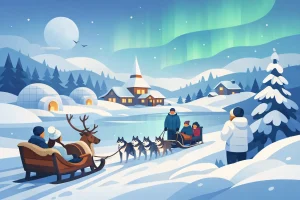
This is especially valuable around Rovaniemi, where travellers often want the full Lapland experience without spending their holiday decoding forecasts. You might have huskies one day, a reindeer safari the next, maybe snowshoeing or ice fishing in between. On an aurora evening, many people do not want to wrestle with three apps, hire car worries and the possibility of ending up in the wrong place under the wrong cloud.
That is where a small-group hunt feels different. It is not just transport. It is local instinct, patience, and an outcome-focused plan built around the real conditions on the night. One mention is enough here: this is exactly why operators like ArKtictopia build aurora experiences around movement, timing and personal attention rather than a fixed photo stop and wishful thinking.
The best app strategy for different travellers
If you are staying several nights in Lapland and have your own car, use My Aurora Forecast or Hello Aurora alongside Windy or YR. That gives you a decent balance of aurora alerts and practical cloud reading. You will still need flexibility, but it is a solid setup.
If you are a photographer, cloud layers and moonlight may matter as much as raw aurora strength. In that case, weather detail becomes even more important than the standard aurora score. A moderate display under clear, dark skies can deliver better images than a stronger display through broken cloud.
If you are travelling as a family or on a romantic short break, the best choice may be to use apps lightly and let them build excitement rather than control the evening. Constant checking can make people feel as if they are missing something, even when they are having a brilliant night in Lapland. Sometimes the better holiday move is to book one serious hunt with guides and treat any extra app-based sightings as a bonus.
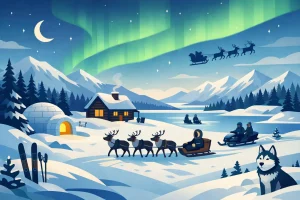
And if you are staying in a glass igloo or remote cabin, remember the sales photos are not the nightly reality. Forecast apps can help you know when to look up, but they do not replace having a proper plan if visibility matters to you.
So, are northern lights apps worth using?
Yes – absolutely. Just do not mistake information for certainty.
The best northern lights forecast apps in Lapland can help you read the night better, manage expectations, and catch opportunities you might otherwise miss. What they cannot do is feel the road, read the horizon, or know which quiet frozen viewpoint will give you the cleanest sky when conditions turn. That part is still gloriously human.
If you come to Lapland with that mindset, the whole experience gets better. Use the apps. Watch the weather. Stay flexible. Then step outside, breathe in that sharp Arctic air, and leave room for the kind of magic that never arrives exactly on schedule.