
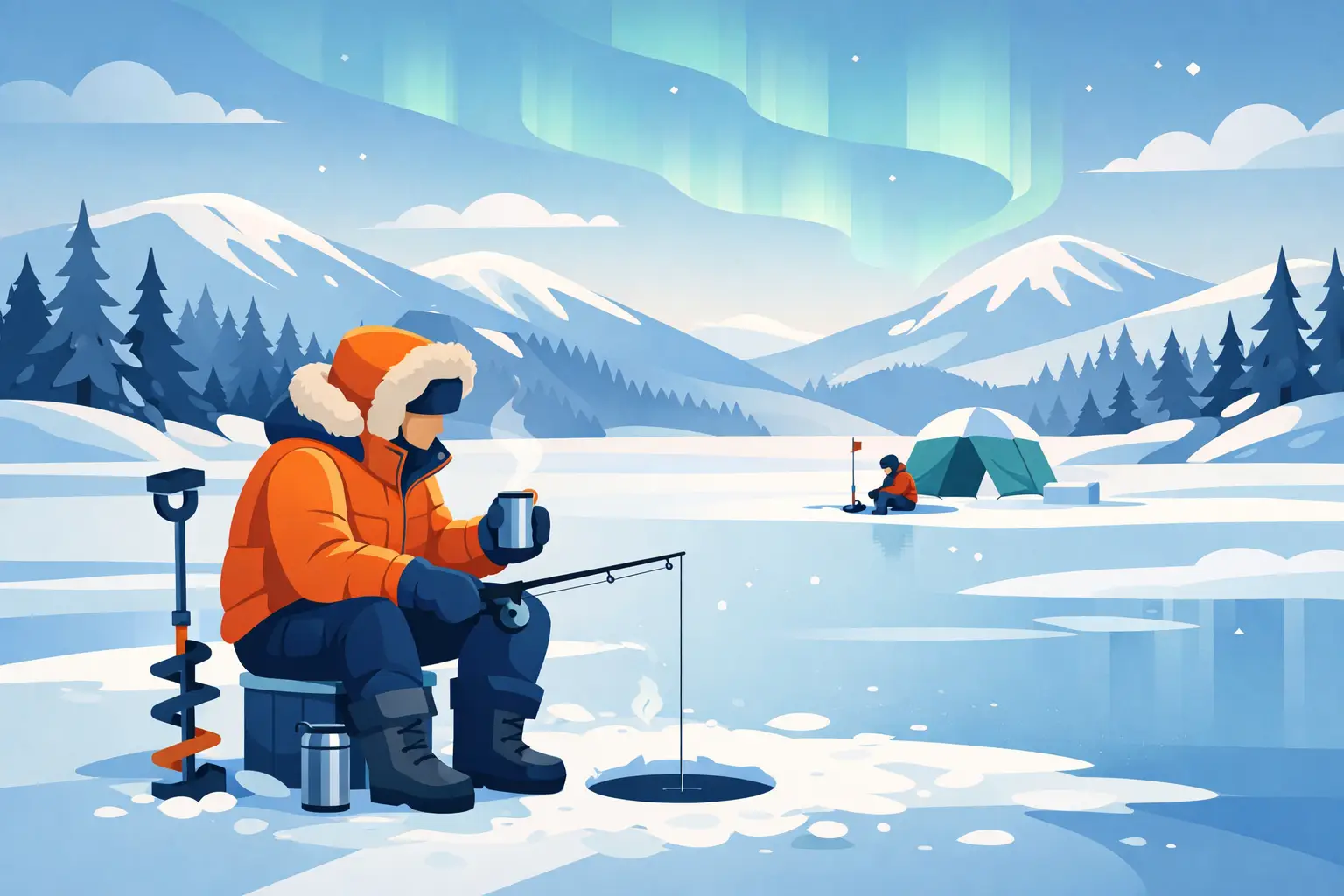
The first quiet minute on a frozen Lapland lake is unforgettable. Snow cushions the forest, the drill cuts through thick ice, and your line disappears into dark water below. But to stay warm ice fishing, you need more than a big coat. You need to manage the changing rhythm of the activity: walking through snow, drilling, sitting still, then waiting patiently for that tug on the line.
The good news is that you do not need to be an Arctic expert. With the right layers, dry feet, sensible pacing and a guide who knows the conditions, ice fishing can feel magical rather than intimidating. That is the real beauty of the experience: the cold is part of the adventure, but it should never take over the day.
How to stay warm while ice fishing
Arctic cold is different from a frosty morning at home. In Rovaniemi, temperatures can sit well below freezing, and a breeze crossing an open lake can make a comfortable day feel much sharper. Your body also cools more quickly when you are stationary, which is exactly what happens once the hole is drilled and the fishing begins.
The goal is not simply to wear as much clothing as possible. Too many bulky layers can make it difficult to move, while overheating on the walk to the lake can leave you damp with sweat. Moisture is the enemy. A good clothing system keeps warm air close to your body, moves moisture away from your skin and blocks wind and snow from reaching the inner layers.
On a guided Lapland experience, thermal overalls and winter boots are often provided. These are designed for the conditions and make a huge difference, especially for visitors arriving from milder parts of Europe. Still, what you wear underneath matters just as much.
Start with dry, breathable layers
Your base layer sits next to your skin, so choose merino wool or a synthetic thermal top and leggings. Both help move moisture away from the body. Cotton does the opposite: once it becomes damp, it stays cold, and that is not what you want on a frozen lake.
Add a warm mid-layer, such as a fleece or wool jumper. This is where most of your insulation comes from. On especially cold days, a second light mid-layer can be more useful than one huge jumper because it traps heat without making you feel restricted.
Your outer layer needs to stop wind and snow. A proper thermal overall does this brilliantly, but if you are wearing your own winter clothing, choose a windproof and water-resistant jacket and trousers with enough room for the layers underneath. Tight clothes reduce the pockets of warm air that help keep you comfortable.
Keep your feet off the cold
The lake ice may be thick, but it still pulls heat from your feet. Standing or sitting in one place for long periods makes this especially noticeable. Proper insulated boots with room for thick socks are essential.
Wear one good pair of wool socks rather than several tight pairs. It sounds counterintuitive, but overfilling a boot can restrict circulation, leaving toes colder. Make sure your boots are dry before heading out, and avoid stepping into deep snow if your footwear is not designed for it.
Your guide may provide a reindeer hide, insulated seat or another barrier between you and the ice. Use it. Sitting directly on the ice, even briefly, drains warmth surprisingly fast. A warm seat is not a luxury – it lets you settle into the peaceful waiting that makes ice fishing so special.
Protect hands, head and neck
Your hands do the practical work: holding the line, baiting the hook and celebrating the catch. Gloves need to be warm, but you may need more dexterity for a moment or two. A useful approach is wearing thin liner gloves under insulated mittens. Keep the mittens on while walking and waiting, then use the liners for small tasks.
Mittens are usually warmer than fingered gloves because your fingers share heat. If your hands run cold, hand warmers can be useful, but they work best as a backup rather than a replacement for proper gloves.
A warm hat that covers your ears, plus a neck warmer or buff, makes an immediate difference. Pull the neck warmer up when the wind picks up, but avoid covering your mouth tightly for long periods. Breath can create moisture and frost in the fabric. A looser fit gives you warmth without leaving a damp patch against your face.
Stay warm ice fishing by managing your pace
Many people feel cold before the fishing even starts because they have worked up a sweat getting dressed or walking through snow. Slow down. You are on Arctic time now.
If you are helping drill the hole or walking across the lake, you may warm up quickly. Open your jacket slightly before you become sweaty, then close it again as soon as you stop moving. That small adjustment is one of the most effective ways to stay comfortable for longer.
Once you are seated, do not wait until you are shivering to act. Wiggle your toes, rotate your ankles, clench and release your hands inside your mittens, and stand for a minute if you need to. Gentle movement keeps circulation going without disturbing the calm of the moment.
Alcohol is not a warming strategy. It can create a brief sensation of warmth while actually making heat loss harder to notice. Save celebratory drinks for later, somewhere warm. On the lake, water and a hot berry juice, tea or coffee from a thermos are far better companions.
Food and hot drinks are part of the kit
Your body needs fuel to produce heat. A good breakfast before departure matters more than most travellers expect, particularly if your tour begins early or lasts several hours. Choose something with slow-release energy: porridge, eggs, yoghurt, bread or fruit all work well.
Bring a small snack if it is not included with your activity. Nuts, flapjacks, chocolate and sandwiches are simple choices, although food can become very hard in deep cold. Keep snacks in an inside pocket where possible.
A hot drink gives both physical warmth and a welcome pause. There is something wonderfully Finnish about warming your hands around a cup while the lake and forest stretch white in every direction. It turns a cold-weather activity into a proper wilderness memory.
Let your guide read the conditions
Temperature is only one part of the picture. A calm day at -15°C can feel more comfortable than a windy day at -5°C. Fresh snow, humidity, cloud cover and how exposed the fishing spot is can all change what you need.
This is why guided ice fishing is such a reassuring choice for first-time visitors. A local guide knows where conditions are sheltered, when to add a layer, how long to stay in one place and when it is time for a warm break. They also handle the equipment and safety checks, leaving you free to focus on the line, the landscape and the possibility of a fish below the ice.
At ArKtictopia, small-group guiding keeps this personal. If someone is getting cold, needs a different glove size or simply wants a moment to warm up, it is noticed. Arctic adventures should feel exciting, never like an endurance test.
A simple pre-lake check
Before you leave your accommodation, take one minute to check the essentials. Make sure your base layers are dry, your mobile phone is charged and tucked into an inside pocket, and your hat, neck warmer and gloves are easy to reach. Pack spare socks if you have them, particularly for a full day of snow activities.
Do not judge the day by how warm you feel in the hotel lobby. Dress for the lake, not the transfer vehicle. You can always loosen a layer when you are moving, but arriving underprepared means your body spends the whole experience trying to catch up.
The reward for getting it right is a rare kind of stillness. Wrapped in warm layers, seated above a world of ice and water, you can hear the soft hush of snow and feel fully present in Finnish Lapland. That is when ice fishing stops being about braving the cold and becomes exactly what it should be: a quiet, unforgettable Arctic adventure.