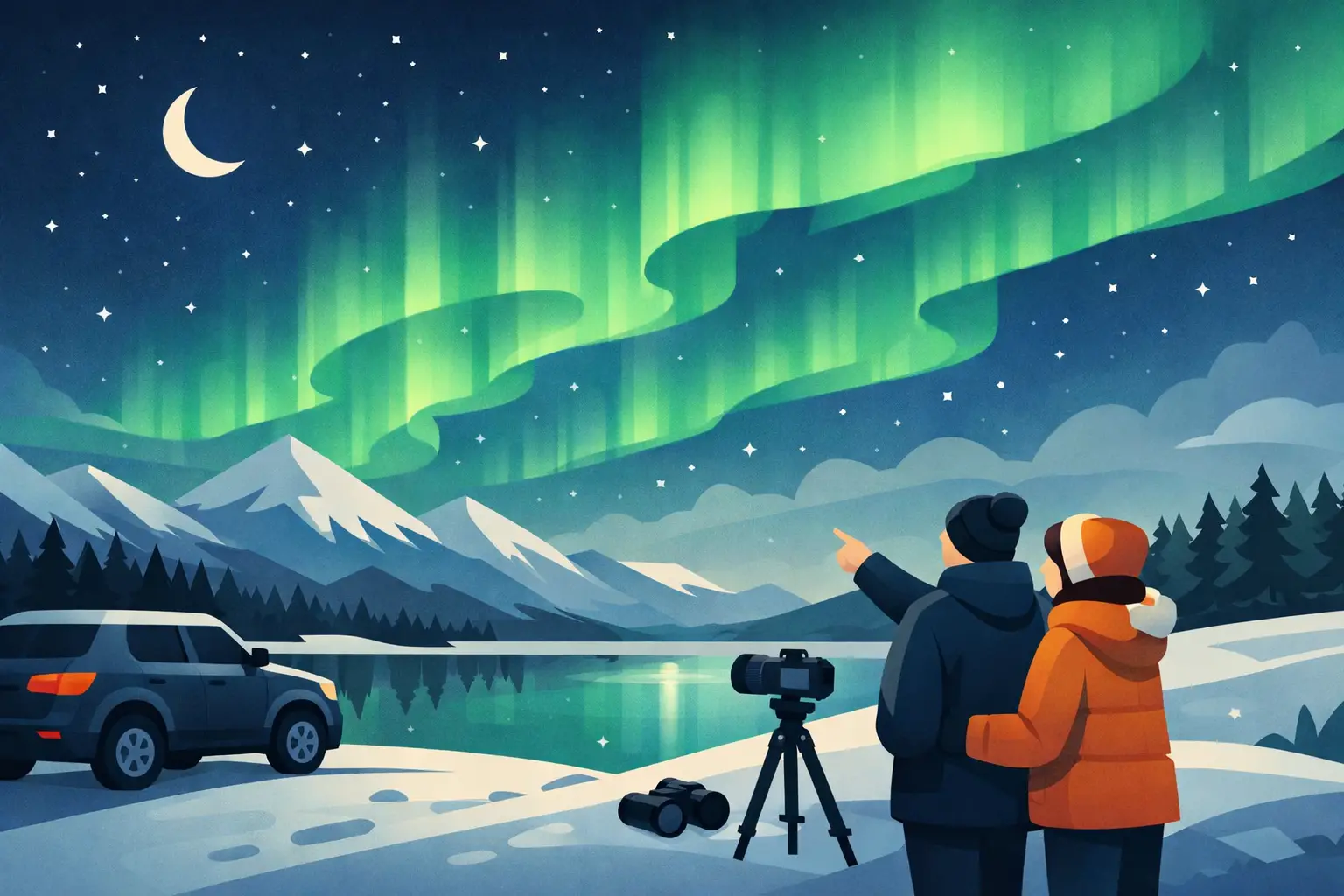
You can stand in Lapland under a perfectly dark sky, wrapped in layers, miles from city glow, and still see nothing. Then, on another night, a guide checks one forecast, changes direction, drives an extra hour, and suddenly the whole sky starts moving. That is how northern lights chasing works in real life – not luck alone, but timing, weather, local knowledge, and a willingness to move fast when the sky gives you a chance.
For most travellers, that is the part that matters. You are not coming to Finnish Lapland to read space weather charts for fun. You want a magical, unforgettable night, and you want the best possible chance of seeing the aurora without spending your holiday guessing where to go. Aurora chasing exists because seeing the northern lights is never as simple as stepping outside and looking up.
How northern lights chasing works in practice
At its core, northern lights chasing is a moving search for the right conditions. The lights themselves are created by solar particles interacting with gases in the Earth’s atmosphere. That sounds dramatic – and it is – but on the ground, a successful hunt depends on something far less romantic: whether the sky is clear where you are standing.
This is why aurora chasing is different from a standard sightseeing trip. A guide is not just taking you to one scenic spot and hoping for the best. They are tracking cloud cover, checking aurora activity forecasts, reading local weather patterns, and choosing routes that give the night the highest odds of delivering.
Some evenings the answer is easy. If skies around Rovaniemi are clear and activity is decent, there may be no reason to drive far. On other nights, low cloud can sit over one area while another is completely open. That is when the chase begins. The plan shifts, the route changes, and a quiet lakeside near town can become a long run towards better conditions.
The three things that decide your chances
People often assume the aurora forecast is everything. It is important, but it is only one piece of the puzzle.
1. Solar activity
The northern lights need enough geomagnetic activity to be visible. Forecasts estimate this using different indicators, including KP level, solar wind speed, and magnetic conditions. Higher numbers can mean stronger displays, but not always in a way that is useful for visitors.
A huge forecast is exciting, yet if cloud covers the whole region, you still will not see a thing. On the other hand, a modest forecast under a clear, dark sky can produce a beautiful show. For travellers, a decent forecast with clear skies often beats a big forecast under poor weather.
2. Cloud cover
This is the real gatekeeper. If thick cloud sits between you and the sky, the aurora may as well not exist. Experienced guides spend a lot of time studying cloud maps because even a narrow gap can make the difference between disappointment and a brilliant night.
In Lapland, weather can change quickly across surprisingly short distances. One village may be fully overcast while another area, an hour away, is open and starry. That is why guided chasing works so well when it is done properly. Mobility matters.
3. Darkness and location
You need darkness to see the lights clearly, especially if the aurora is faint. That means getting away from streetlights, built-up areas, and bright roads where possible. It also means understanding the season. In winter, Lapland gives you long hours of darkness, which creates more opportunity. But moonlight, haze, snowfall, and local light pollution still affect what you see.
A good chase location is not just remote. It is a place with open sky, low artificial light, safe access, and a clear view in the right direction. Frozen lakes, forest clearings, quiet roadsides and hilltops can all work, depending on the conditions.
Why aurora chasing is not just “driving around”
From the outside, a northern lights hunt can sound simple: get in a minibus and keep moving until something appears. Real chasing is more deliberate than that.
Guides build decisions in layers. They start with broad regional forecasts, then narrow down likely cloud breaks, then consider wind direction, local microclimates, road conditions, and how much time is realistic for the group. They also know which spots are worth trying first and which routes offer backup options if the weather shifts.
That local judgement is where experience counts. Forecasts are useful, but they are not perfect. In Arctic winter, conditions on a screen and conditions on the road are not always the same thing. A guide who knows the terrain can make sharper calls than someone relying only on an app.
There is also a trade-off between chasing hard and keeping the experience enjoyable. Driving hundreds of kilometres might sound impressive, but if guests spend the whole night exhausted in transit, the evening loses some magic. The best hunts balance determination with comfort. Small groups help here because decisions are quicker, stops are easier to manage, and the whole experience feels personal rather than rushed.
What happens on a guided hunt
A typical evening begins before the first engine starts. Weather and aurora checks happen in advance, and the route is often decided close to departure time because conditions can change right up to the last moment.
Once the group sets off, the guide keeps monitoring the sky. Sometimes there is one main destination. Sometimes there are several possible stops depending on what the clouds do. If the first location is not working, the group moves. If a gap opens elsewhere, the plan changes. That flexibility is the whole point.
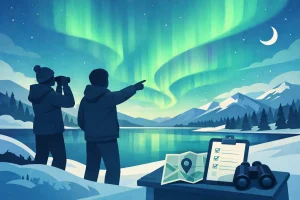
When the right place is found, there is often a wait. This surprises some travellers. The aurora does not perform on command. It can begin as a faint green arc that barely registers at first, then strengthen into moving bands, curtains or swirling shapes. Patience is part of the experience.
This is also why dressing properly matters. Chasing is not only about sitting in a vehicle. You may spend meaningful time standing still in deep cold, watching the sky, taking photographs, or simply hoping the next ten minutes become unforgettable.
How photography changes the chase
If your goal is strong photographs rather than simply seeing the lights, the hunt becomes even more selective. Guides may prioritise darker locations, cleaner foregrounds, and places with minimal stray light. They may also favour stops where you can set up a tripod safely and stay longer if the display develops.
Photography-focused hunts often move at a slightly different rhythm. Guests need help with camera settings, and the group may spend more time at one carefully chosen spot. That can be brilliant if you want proper aurora images, but it is worth knowing that a photo hunt and a standard hunt are not always the same experience.
Phone cameras have improved massively, but they still have limits. Many people see a faint aurora with their eyes and a stronger green result on their screen. That does not mean the photo is fake. It means the camera sensor captures light differently. A guide can explain that on the night, which helps manage expectations before anyone feels confused or disappointed.
The biggest myth: no one can guarantee the sky
This is the honest bit. No operator, no matter how experienced, can guarantee the northern lights themselves. Solar activity and weather remain outside human control.
What a serious aurora company can do is maximise your chances. That means planning around forecasts, using local knowledge, choosing small-group formats that stay flexible, and putting real effort into finding clear skies instead of parking at one fixed viewpoint and calling it a hunt.
That difference matters. If you are choosing between operators for your Lapland holiday, ask how they actually chase. Do they move if conditions demand it? Do they adapt routes on the same day? Are groups small enough to stay agile? Those details tell you far more than glossy wording ever will.
For many visitors, especially couples, families and first-time Arctic travellers, a guided hunt removes the stress that can drain the magic out of the evening. You do not need to hire a car, decode forecasts, or work out whether a snowy side road is sensible after dark. You can simply focus on the experience while someone else handles the hard decisions. That is exactly why guided aurora trips remain one of the smartest ways to experience Lapland.
How northern lights chasing works best for travellers
The best approach is not to treat one night as your only chance. If your holiday allows it, give yourself more than one opportunity. Conditions change daily, and even a difficult forecast can turn around. Travellers who build in flexibility usually feel less pressure and enjoy the process more.
It also helps to choose a hunt that matches your priorities. If you want a social evening with warmth and comfort, a standard small-group chase may be perfect. If you want privacy, more control over pacing, or a special occasion feel, a private hunt can be worth it. If images matter as much as the experience, a photo-focused tour gives you a better fit. Operators such as ArKtictopia build these formats for a reason – not every traveller wants the same kind of night.
And finally, keep your expectations realistic in the right way. Realistic does not mean lowering the magic. It means understanding that aurora chasing is part science, part fieldcraft, and part waiting in the cold with your eyes on a silent sky. When it works, it feels extraordinary precisely because it was never guaranteed.
That is the beauty of it. Northern lights chasing is not a staged attraction. It is a real pursuit in a real Arctic night – and when the sky finally opens, it feels earned.