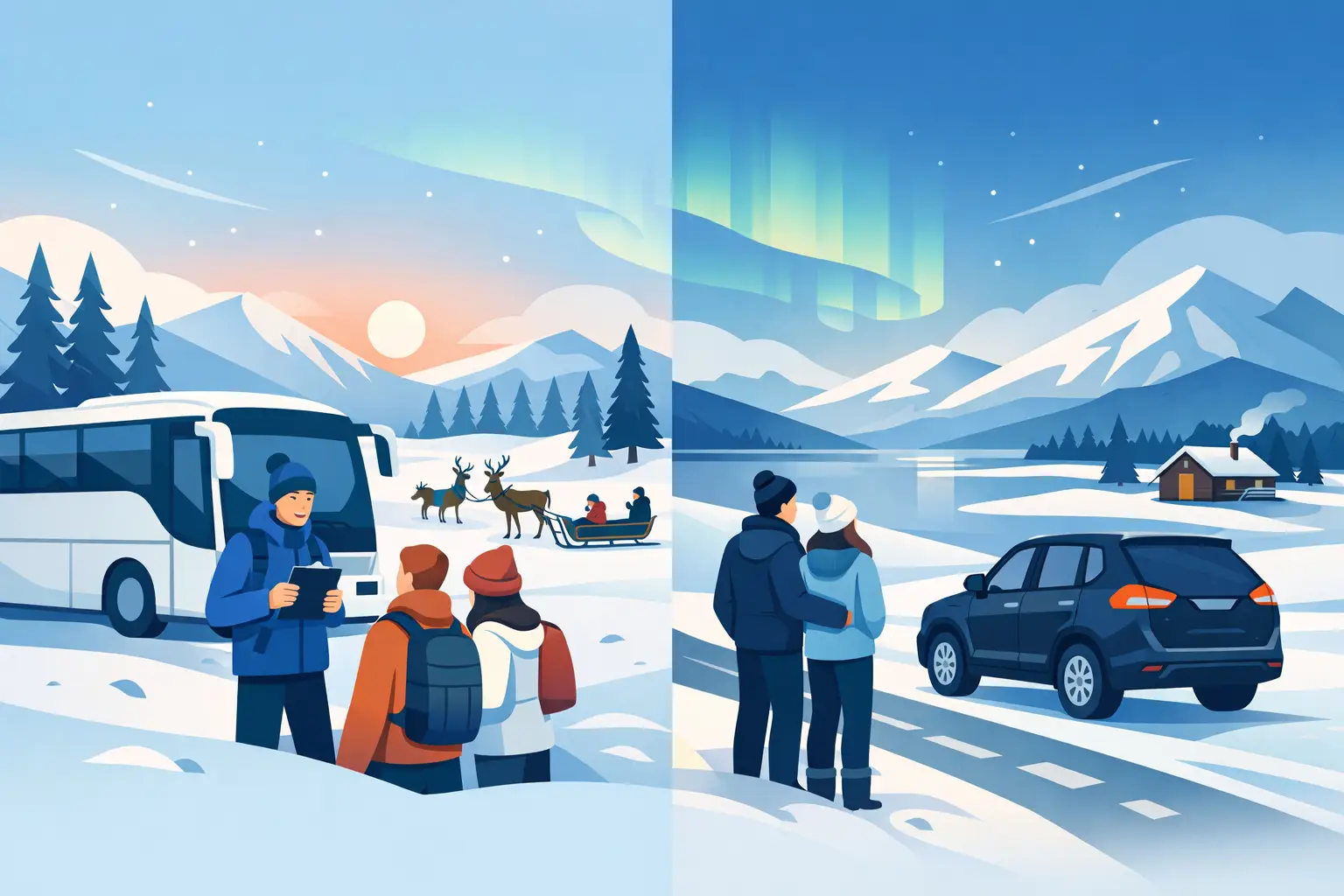
You can hire a car in Rovaniemi, load the boot with winter layers, and point yourself towards the white horizon. That freedom feels brilliant for about ten minutes – right up until the road turns glassy, daylight starts fading by mid-afternoon, and you realise a guided day trip or self drive is not just a budget question. In Lapland, it shapes what kind of holiday you actually have.
For some travellers, self-driving is part of the adventure. For others, it quietly adds stress to a trip that was meant to feel magical. The right choice depends on what you want most from your time in the Arctic: independence, simplicity, better access to local knowledge, or the strongest possible chance of seeing the Northern Lights.
Guided day trip or self drive: what are you really choosing?
On paper, the decision looks simple. A self-drive day gives you control over your route, your stops and your schedule. A guided tour gives you transport, structure and a local expert who knows the terrain. But in Finnish Lapland, the gap between those two experiences is wider than many first-time visitors expect.
A self-drive day asks you to manage winter roads, parking, timing, weather shifts and navigation in an unfamiliar environment. A guided day trip removes those moving parts. You step into the experience instead of building it yourself.
That matters even more in winter, when conditions change quickly and distances can feel deceptively manageable on a map. Thirty kilometres in Lapland is not the same as thirty kilometres on a mild Saturday in the UK.
Why guided trips often feel better in Lapland
The biggest advantage of a guided day trip is not just convenience. It is access. Access to local judgement, to places you would probably miss, and to the kind of small details that turn a nice excursion into an unforgettable one.
Take an aurora hunt. With a rental car, you can absolutely head out and search for clear skies on your own. Plenty of people do. But you are relying on your own interpretation of forecasts, road confidence at night, and guesswork about where light pollution drops away. A good guide is constantly reading the conditions, adjusting the route and making decisions based on experience rather than hope.
The same applies to snowshoeing, wildlife spots and heritage stops. The Arctic is full of places that look beautiful on Instagram but tell you very little once you arrive. With a guide, the landscape comes alive. You hear the stories, understand what you are seeing and spend less time wondering whether you have gone the wrong way.
For couples and small groups, guided days also tend to feel more relaxed. Nobody has to be the designated driver. Nobody is squinting at road signs in the dark. Everyone gets to be present.
When self-drive makes sense
Self-drive is not the wrong choice. It just suits a different traveller.
If you are confident driving in snow, comfortable with rural winter roads and genuinely enjoy planning your own days, it can be a great way to explore. It works particularly well if your priority is freedom rather than outcomes. Maybe you want to take your time at a scenic viewpoint, combine a café stop with a walk, or build a gentler family day without fixed timings.
It can also make sense if you are staying longer in Lapland and want a mix of guided experiences and independent wandering. Hiring a car for a few days around a tour-led itinerary can be the sweet spot. You get the confidence and local insight of guided excursions for your big-ticket experiences, then keep some open time for your own pace.
The catch is that self-drive only feels liberating when you are prepared for it. If winter driving already makes you tense, Lapland is unlikely to cure that.
Cost is not as straightforward as it looks
People often assume self-drive is the cheaper option. Sometimes it is, but not always once you count everything properly.
A rental car comes with the daily rate, fuel, insurance choices and the occasional extra cost that seems minor until it is not. Then there is the value of your own time: route planning, parking decisions, checking opening hours, reading weather conditions and accepting that if you misjudge the day, that is on you.
A guided day trip usually rolls transport, planning and expertise into one clear price. That can look higher at first glance, but it buys ease. It also reduces the risk of wasting one of your limited Lapland days on a plan that looked good on Google Maps and felt very different in reality.
For travellers on a short winter break, that matters. If you have three or four days in Rovaniemi, convenience is not a luxury. It is part of making the trip work.
Guided day trip or self drive for Northern Lights chasing
If the Northern Lights are high on your wish list, this is where the choice becomes sharper.
Aurora hunting is not a scenic evening drive. It is a moving target shaped by cloud cover, solar activity, timing and darkness. A self-drive approach can work on a clear night if you know where to go and are happy to keep adapting. But many visitors underestimate how much of aurora success is about reading local conditions in real time.
A guided hunt gives you better odds because the whole format is built around the outcome. Routes can shift. Timings can stretch. The plan can change if a better weather window opens in another direction. That flexibility is hard to replicate on your own, especially if you do not know the roads or the region.
Photography is another factor. If you are hoping for proper images rather than blurry phone attempts, a guide can help with camera settings, positioning and timing while you focus on the moment instead of juggling everything at once.
No honest operator can promise the sky will perform on command. But a well-run guided hunt gives you a smarter shot than simply driving into the dark and hoping for the best.
Safety matters more than people admit
Most visitors are sensible enough to respect Arctic winter, but plenty still imagine Lapland as a prettier version of home. It is not. Roads can be compacted snow, temperatures can drop hard, and daylight is short. Add fatigue, unfamiliar cars and the pressure of wanting to fit a lot into one day, and small mistakes become more likely.
That does not mean self-driving is dangerous by default. It means it deserves proper respect. If you are experienced, calm in winter conditions and realistic about your limits, you may be absolutely fine. If not, guided travel is often the wiser call.
There is also the softer side of safety: decision fatigue. Holidays are supposed to give you a break from managing every detail. On a guided trip, someone else is watching the clock, reading the route and handling the practical side while you enjoy the Arctic for what it is – wild, quiet and extraordinary.
The best choice depends on your travel style
If you are travelling as a family, a guided day usually wins on ease. Children get restless, layers need adjusting, and the day runs better when logistics are handled for you. If you are a couple on a once-in-a-lifetime winter break, guided experiences often feel more special because you are both fully in the moment.
If you are a confident independent traveller with time to spare, self-drive may be part of the fun. You can chase your own rhythm and stop whenever the forest looks especially beautiful. But if your holiday is short and packed with expectations, guidance usually brings more value than freedom.
That is why many experienced Lapland visitors mix both. They book guided tours for high-stakes experiences like aurora hunting, huskies or wildlife days, then keep one or two self-led outings for slower exploration. It is a balanced approach and, for many, the smartest one.
For travellers who want the real Arctic without the guesswork, this is where a small-group operator such as ArKtictopia earns its place. Not because independence is bad, but because local knowledge, personal attention and outcome-focused planning can turn a good day into the day you talk about for years.
So, should you book or drive?
Choose self-drive if freedom is your priority, you are confident in winter conditions and you do not mind carrying the responsibility for how the day unfolds. Choose guided if you want a smoother experience, stronger local insight and better use of limited time.
Lapland is magical either way, but magical does not mean effortless. The Arctic gives back most when you travel in a way that suits your confidence, your expectations and the kind of memories you came here to make.
If you are torn, that is usually your answer. Keep the car for the easy wandering, and let the experts handle the moments that matter most.