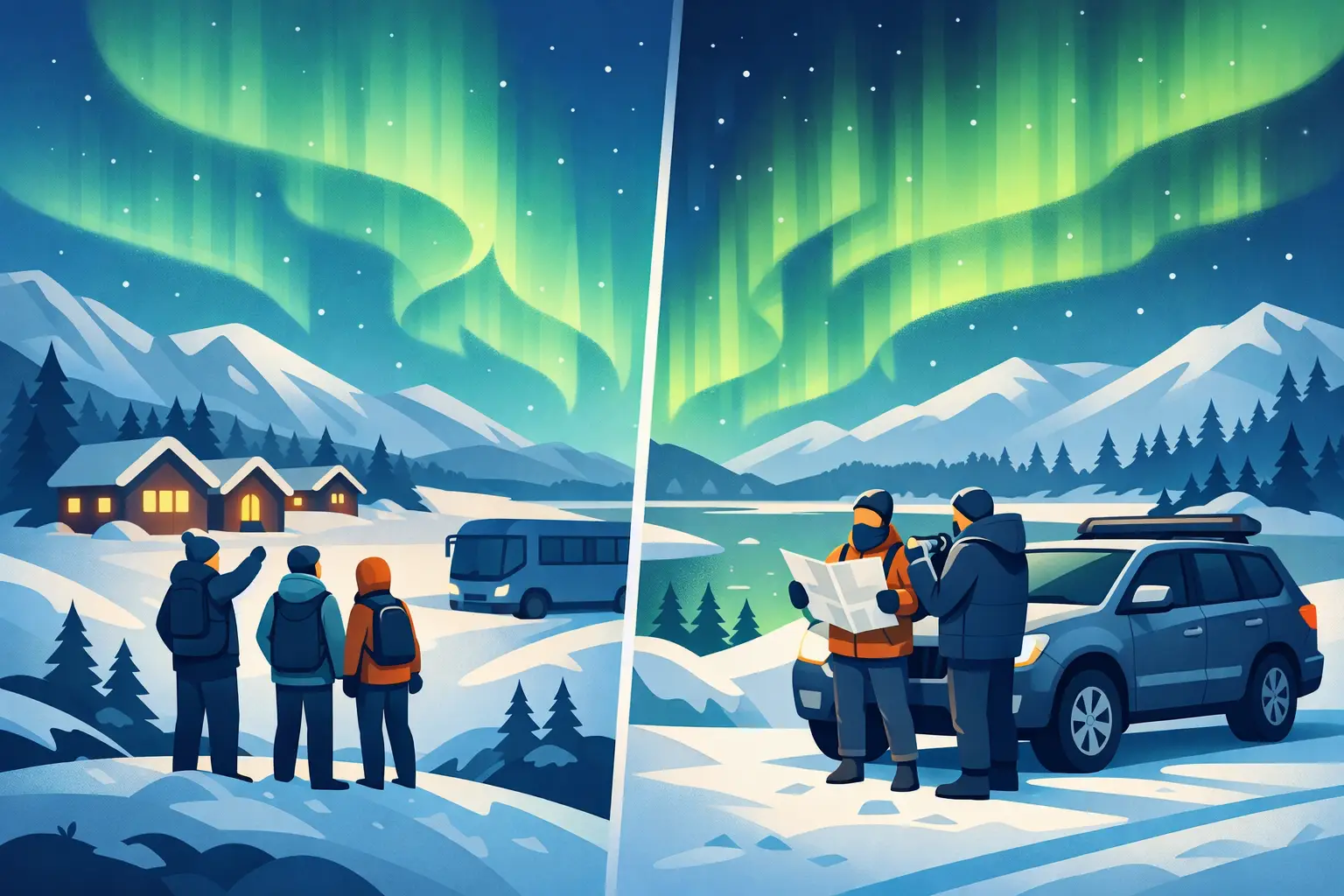
You land in Rovaniemi, the snow is glowing blue, the forecast looks promising, and suddenly the big trip question feels very real: aurora tour vs self drive Lapland. Both can lead you into wild, silent nights under Arctic skies. But they create completely different holidays – and if your main goal is actually seeing the Northern Lights rather than just hoping for them, the choice matters.
Lapland has a way of making everything feel magical. It also has a way of humbling overconfident travel plans. Distances are longer than they look, weather shifts fast, and a clear sky in one area can become thick cloud twenty minutes later. That is exactly why the tour-versus-car debate is not just about money or independence. It is about what kind of Arctic experience you want, and how much responsibility you want to carry when darkness, ice and timing all come into play.
Aurora tour vs self drive Lapland: what really changes?
On paper, self-driving sounds simple. Hire a car, watch the forecast, head out, park somewhere dark, and wait for the show. If you like freedom, that idea is undeniably appealing. You choose your own pace, stop where you want, and can build your evenings around dinner plans, family routines or photography.
A guided aurora tour is built differently. It is not simply transport to a dark car park. A good one is an active chase led by people who spend winter doing exactly this – reading cloud cover, checking local conditions, knowing which roads stay practical, and understanding where artificial light, tree cover and horizon lines will affect what you see. The best tours are designed around outcomes, not just itinerary boxes.
That difference becomes clearer the moment conditions are mixed. On a self-drive night, you are making live decisions with limited local knowledge. On a tour, someone else is already thinking three moves ahead.
When self-driving in Lapland makes sense
Self-drive can be a brilliant option if the Northern Lights are one part of a broader trip rather than the whole point of it. If you are planning several nights in Lapland, staying outside the city, and feel comfortable driving in winter conditions, a car gives you flexibility. You can combine daytime exploring with evening aurora attempts, visit quieter areas at your own pace, and avoid the structure of fixed departure times.
It also suits travellers who genuinely enjoy the process. Some people love the independence of checking conditions, finding a remote lay-by, setting up a flask and camera, and waiting in the stillness. If that sounds romantic rather than stressful, self-drive may fit your style.
But there is a catch. Freedom only works well when you are equipped to use it. That means confidence on icy roads, comfort with darkness on unlit routes, and a realistic sense of how tiring winter driving can be after a full day of activities. A road in Lapland may be well maintained, but that does not make it familiar. For visitors from Britain, the combination of snow, darkness and right-hand traffic can turn a dreamy plan into a tense one rather quickly.
When a guided aurora tour is the better call
If seeing the lights is a headline reason for your trip, a guided tour is usually the stronger choice. Not because it guarantees nature will perform on command, but because it gives you a smarter, more focused attempt.
That matters especially on short breaks. Many travellers from the UK come to Lapland for three or four nights and want every evening to count. In that situation, spending one of those nights learning by trial and error in a hire car can feel expensive. A tour compresses local knowledge, route planning and practical judgement into one experience. You are not wasting your best window wondering whether you should have driven another forty minutes north.
It is also the easier option emotionally. You are there to enjoy the Arctic, not spend the evening second-guessing weather maps in a car park. Small-group tours feel especially different from the big coach-style versions many people picture. With the right guide, the night becomes personal – stories, warm drinks, real conversation, and the sense that someone is fully invested in making the experience count.
For couples, first-time winter travellers, families and solo visitors, that support often changes the whole trip.
Cost is not as straightforward as it looks
The budget argument is where many people instinctively lean towards self-drive. A tour price can look higher at first glance. But Lapland travel has a habit of hiding costs inside the details.
With self-drive, you are paying for car hire, fuel, possible winter driving add-ons, parking in some places, and the not-so-small cost of time. If your chase involves multiple evenings of trial runs, that adds up. If conditions are poor and you drive long distances looking for a break in the cloud, it adds up faster.
A guided tour bundles the expertise, routing, pick-up, and often winter gear support or camp elements into one booking. You are paying for the result-focused design, not just the seat in the vehicle. For travellers on short breaks, that can be better value than it first appears.
This is where cheap and good value part ways. Cheap is doing it all yourself and hoping for the best. Good value is giving yourself a stronger chance of an unforgettable night.
Aurora chances: who has the edge?
If we strip away the romance and answer honestly, guided tours usually have the edge.
Not because guides control the sky – nobody does. But experienced aurora guides know how to react to conditions with speed and purpose. They understand the local microclimates, the practical road network, and where to go when one direction closes down under cloud. They also know that a good aurora night is not only about darkness. Horizon visibility, moonlight, snow reflection, local light pollution and timing all shape what you actually experience.
Self-driving can absolutely lead to an incredible sighting, especially during stable, clear weather. If the forecast is excellent across a wide area, the gap narrows. On those nights, almost anyone who gets away from city lights has a fair shot.
But Lapland is rarely that tidy for an entire week. More often, it is patchy. And patchy nights reward local knowledge.
Safety and stress in real winter conditions
This part is less glamorous, but it matters. Driving in Lapland is not impossible, and plenty of visitors do it successfully. Still, there is a difference between being able to drive and wanting to drive late at night on icy roads while monitoring aurora alerts, checking cloud maps and searching for a stopping point.
Fatigue plays a bigger role than people expect. In midwinter, your body clock can feel strange, days are activity-heavy, and the cold drains energy. Add children in the back, camera gear in the boot, or nerves about unfamiliar roads, and the self-drive plan can lose its shine.
A tour removes that mental load. You can look out of the window, stay present, and enjoy the build-up instead of concentrating on road signs and ice. That is not a small thing on a once-in-a-lifetime holiday.
Which option suits your travel style?
The best answer in the aurora tour vs self drive Lapland debate depends on what kind of traveller you are.
If you want independence, have several nights available, are staying in a quieter location, and feel fully comfortable driving in Arctic winter conditions, self-drive can be rewarding. It gives you freedom and a sense of discovery that some travellers genuinely love.
If you are on a shorter break, want to maximise your chances, prefer not to wrestle with icy roads, or simply want the night to feel exciting rather than logistical, a guided hunt is the smarter choice. That is especially true if you are new to Lapland. There is a reason experienced local operators build tours around small groups, flexible routing and personal attention. It works.
For many travellers, the strongest plan is actually a mix. Book one serious guided aurora hunt early in your stay, then use any extra clear evenings for your own relaxed attempts if you have a car. That way you get both structure and freedom, without putting all the pressure on one approach.
At ArKtictopia, that is exactly how we think about Lapland – not as a postcard backdrop, but as a real Arctic environment where good decisions shape unforgettable nights. The magic is real, but the planning matters too.
If your dream is to stand under a moving green sky and feel that rare, breathless moment when the Arctic delivers, choose the option that lets you be present when it happens – not the one that leaves you wishing you had made the night easier.