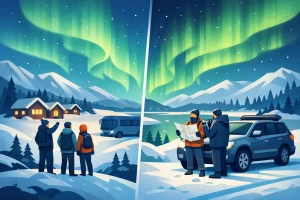
At 6pm, the sky above Rovaniemi can look hopeless – low cloud, light snow, no stars, no promise. Then your guide checks three forecasts, reads the wind shift, heads east for clearer air, and by 9.30pm you are standing beside a frozen lake watching green bands roll across the horizon. That is why a real example aurora chase itinerary matters more than a glossy promise. The magic is real, but the route is built on decisions.
A real example aurora chase itinerary from Rovaniemi
If you are planning a winter break in Finnish Lapland, it helps to know what an aurora chase actually looks like in practice. Not the polished version where the sky performs on cue, but the real one – with weather checks, changing routes, roadside stops, hot drinks, waiting, and the thrill of seeing the night suddenly come alive.
This example is based on the kind of evening many travellers want most: a guided chase from Rovaniemi with a small group, flexible routing, and the best possible chance of finding clear skies. It is not a fixed bus timetable. A proper aurora chase should never be that. Northern Lights tours work best when the plan stays flexible enough to follow the weather.
16:00 – The weather check begins
Long before pick-up, the work starts. Aurora hunting is never just about solar activity. You can have excellent aurora forecast numbers and still see nothing if the cloud sits thick over Lapland. A guide will usually compare cloud cover maps, satellite views, local webcams, road conditions and the strength of the auroral oval.
On this example night, Rovaniemi is mostly overcast. There are possible breaks westward, but a wider pocket of clear sky looks more promising to the east near the Russian border direction. Wind speeds are manageable, temperatures sit around -18C, and roads are open. That changes the whole game. The route is no longer about finding the nearest dark spot. It is about outrunning cloud.
18:00 – Pick-up in Rovaniemi
Guests are collected from accommodation in and around the city. A good guide sets expectations early. No serious operator should guarantee the Northern Lights on demand unless the product is specifically built around repeated attempts or a very particular promise. What they can do is maximise your odds with smart routing, local knowledge and patience.
This is also the moment to check everyone is dressed properly. Even if you are mostly in the vehicle, aurora chasing involves bursts of standing still in deep cold. Thick socks, proper boots, gloves, insulated layers and something windproof matter more than people think. If you are cold after ten minutes outside, the night starts to feel very long.
How the route changes in a real example aurora chase itinerary
By 18:30, the group leaves Rovaniemi. The first planned viewpoint is not final – it is simply the best opening move. On this evening, the guide heads south-east along quieter roads where forest gaps, frozen rivers and lake edges offer clean northern views. Driving time is part of the strategy. Around Rovaniemi itself, street glow and local cloud often block the best opportunities.
The first stop comes at roughly 19:20 near an open lakeside area. There is no aurora yet, but one bright star appears through a broken patch in the cloud. That is enough reason to stay fifteen minutes. This is one of the trade-offs people rarely hear about. Chase too aggressively and you spend the whole evening in the minibus. Stop too often and you waste your window. Experienced guiding is knowing when to wait and when to move.
At 19:40, the clouds begin thickening again from the west. The guide decides to continue another 45 minutes. Not because the forecast is perfect ahead, but because it is better. Aurora chasing is often about choosing the least bad option until the sky opens.
20:30 – Second stop, first signs of hope
The next location is a roadside clearing near a frozen marsh with a broad view north. This time the stars are properly visible. Guests step out, eyes adjust, cameras come out, and the guide points to a faint pale streak above the treeline. At first it looks like thin cloud. Then it brightens and arches. That is often how the aurora begins – quietly, almost suspiciously, before anyone quite believes it.
For the next twenty minutes, the display stays soft. Enough for photos, enough for excitement, but not yet the dramatic curtains people dream about. This is where realistic expectations matter. Some nights give a wild overhead storm. Others offer a delicate green ribbon low on the horizon. Both count as seeing the Northern Lights, but they feel very different.
The guide keeps everyone moving between warming up in the vehicle and stepping out for short periods. Hot berry juice and biscuits appear. It sounds simple, but comfort changes the experience. Small groups have a real advantage here. Less waiting, less confusion, more personal help with camera settings and more freedom to move fast if the sky shifts.
21:15 – The decision that makes the night
Cloud begins creeping in again. Staying put would be comfortable, but the satellite view shows a wider clear band opening further east. The guide makes the call to drive. This is the moment many successful hunts are built on. Not luck alone, but a willingness to leave a decent spot for a better one.
The road narrows, traffic disappears, and the forest thickens on both sides. By 21:50 the group reaches a frozen lake with almost no artificial light. The sky is now properly clear. You can see constellations sharply, the snow reflects a faint blue glow, and there is that electric feeling that the night is about to do something memorable.
Then it happens.
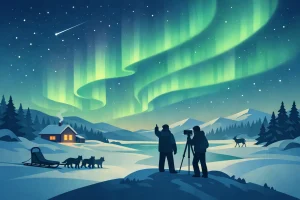
At 22:05, the aurora lifts from the horizon in a stronger arc, stretches overhead and begins to move. Green brightens to a flowing ribbon. A second band forms behind it. For a few minutes, the entire sky looks alive – not static colour, but motion. This is the part photographs struggle to explain. The lights seem to breathe.
Some guests go quiet. Others laugh, swear, point, or simply stand still in total disbelief. It is one of those rare travel moments that feels bigger than the plan you made to get there.
22:15 – Photography, patience and staying longer
A lot of people imagine the aurora as one dramatic burst and then it is over. In reality, a strong display can pulse, fade and return over an hour or more. On this example night, the guide keeps the group at the lake for nearly an hour. There are portraits, landscape shots, help with mobile phone settings, and time just to watch.
This matters because rushing out the moment the lights appear can turn an unforgettable evening into a hurried box-ticking exercise. The best tours leave room for the experience itself. Not every minute has to be optimised. Sometimes the right move is simply to stay still in the snow and look up.
23:10 – Return to Rovaniemi
The drive back begins once the cloud starts building again and the display weakens. People are tired, happy and a little stunned. The route home feels shorter. That is often the way after a successful chase.
Back in Rovaniemi around 00:30, the practical side returns – warm room, late snack, boots off, checking your camera roll to make sure it really happened. But the shape of the evening is what stays with you. Not just the lights, but the feeling of being out in the Arctic night, following the weather through silent forests and frozen landscapes until the sky finally opened.
What this real example aurora chase itinerary tells you
The biggest lesson is that a good aurora hunt is not a static excursion. It is a moving target. Some nights the best viewing point is twenty minutes from town. On others, it may be two or three hours away. That depends on cloud cover, road conditions, group energy and how strong the aurora activity really is.
It also shows why small-group guiding matters. If your goal is simply to sit by a fire and hope, almost any evening tour will do. If your goal is to maximise your chances, you want flexible logistics, active decision-making and a guide who treats the forecast like a live puzzle rather than a brochure line.
That is where operators built around The Real experience stand apart. At ArKtictopia, the best nights are not manufactured. They are earned through route choices, local knowledge, honest expectations and a proper commitment to the chase.
If you are building your own Lapland trip, think of aurora hunting as the wild card night worth protecting. Leave space in your itinerary, dress better than you think you need to, and choose the kind of tour that is willing to adapt. The Northern Lights do not care about your schedule – but with the right guide, your chances can still become something magical.